Growth Navigate Funding: Expert Fundraising and Business Growth Solutions

Raising money feels like climbing a mountain in fog. You know the summit exists. You just can’t see the path. Many founders spend months chasing investors and still stall at the first meeting. Growth Navigate Funding clears that fog. It turns a scattered raise into a clear, staged plan.
This guide explains how Growth Navigate Funding services work. You’ll see how a fundraising strategy takes shape and how a strong pitch deck development process wins attention. You’ll also learn how investor relations services open doors. Whether you run a young startup or an established firm, you’ll find practical steps here. Grab a coffee. Let’s get moving.
What Is Growth Navigate Funding?
Growth Navigate Funding is an advisory partner for founders and business owners. It helps teams raise capital, meet investors, and scale. Think of it as a trail guide who knows every switchback on the way up.
Read More: FentoMagazine.com USA: Trusted Technology, Business, Lifestyle & Digital Innovation Guide
The Growth Navigate Funding company works with teams from pre-seed through Series C. It offers startup funding solutions and business funding advisory under one roof. You get strategy, materials, introductions, and growth support in one place.
Why does that matter? Most founders try to raise money alone. They build a deck at midnight. They email strangers. They guess at company valuation. A fundraising consulting partner replaces guesswork with a plan. The table below shows the difference.
| Area | Going Solo | With an Advisory Partner |
| Fundraising strategy | Built from scratch | Tested roadmap |
| Investor access | Cold emails | Warm introductions |
| Materials | Rushed deck and model | Investor-grade documents |
| Diligence | Surprises late in the deal | Prepared in advance |
| Time to close | Often longer | Usually shorter |
Of course, no advisor can promise a result. Markets shift. Investors say no. A good partner simply raises your odds and sharpens your story.
Growth Navigate Funding Services for Startups and Businesses
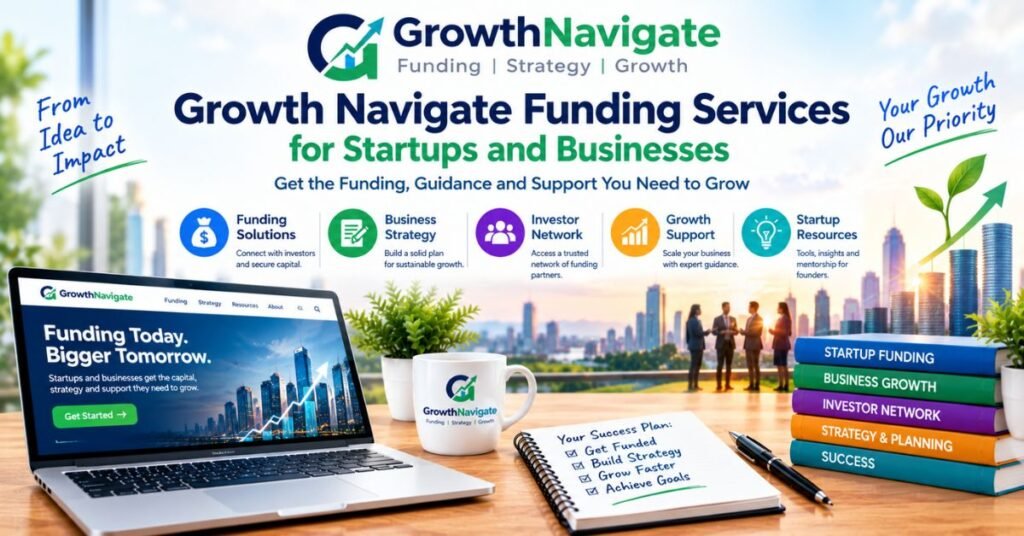
The service toolkit covers the full startup funding process. It starts with planning and ends with a signed deal. Along the way you get startup fundraising services, funding advisory services, and business growth consulting. Each service feeds the next one. Your fundraising strategy shapes your deck. Your deck shapes your meetings. Your meetings shape your term sheet. Nothing sits alone.
Here’s a quick view of how each service maps to a problem and a stage.
| Service | Problem It Solves | Best Stage |
| Fundraising strategy | No clear plan or target | Pre-seed to Series C |
| Pitch deck development | Weak first impression | Seed and Series A funding |
| Investor relations services | No access to investors | Seed and beyond |
| Financial modeling services | Shaky numbers | All stages |
| Growth strategy consulting | Stalled traction | Post-funding |
| Due diligence preparation | Deals that collapse late | Late-stage rounds |
Fundraising Strategy and Capital Planning
Every raise begins with three questions. How much do you need? When do you need it? And who should write the check? A solid fundraising strategy answers all three. Startup capital planning starts with your runway, which is the number of months your cash will last. Then it sets your funding requirements against your next big milestones.
If you raise too little, you stall. If you raise too much, you give away more ownership than you need. Good capital raising strategies also weigh equity financing against debt financing. Equity trades ownership for cash. Debt keeps ownership but adds repayments. Your investment strategy should match your growth pace. A Growth Navigate Funding roadmap lays out your funding rounds, your fundraising milestones, and your target investors. This is how you learn how to develop a successful fundraising strategy instead of just hoping for the best. Treat it like a map. It keeps you from wandering.
Pitch Deck Development for Investors
Investors skim. Many give a deck only a few minutes at first glance. So your investor pitch deck must hook fast. Professional pitch deck development builds a clear story around the problem, the solution, the market, the traction, and the ask. Each slide should earn its place. A sample order works well: problem, solution, product, market size, business model, traction, team, financial projections, and the ask.
Read More: WiseStudySpot.com: Your Hub for AI Tools, Latest Tech News, Software Reviews, and How-To Guides
This is how to create an effective investor pitch deck that people finish reading. Strong investor presentation skills matter too. You must say the story out loud with ease. Practice until it feels natural. Cut jargon. Show numbers that you can defend. A deck isn’t a brochure. It’s a conversation starter that makes a stranger want a second meeting.
Investor Relations and Investor Access
Cold outreach rarely works. Warm introductions do. That’s where investor relations services earn their keep. A strong investor network gives you access to venture capital investors, angel investors, family offices, and institutional investors. Each group wants something different. Angels often move fast and back people. Funds want scale and clear returns. Venture capital funding suits fast-growing companies.
Private equity funding often suits mature firms that want to expand. Smart investor outreach targets the right investors for your stage and sector. It also keeps relationships warm after the first call. This is how you find investors for business expansion and learn how to build relationships with investors over time. Good investor communication is simple. Send honest updates. Share wins and misses. Trust grows from steady contact.
Financial Modeling and Business Valuation
Numbers tell investors whether your story holds up. Reliable financial modeling services turn your plan into data. A good model includes revenue forecasting, cash flow analysis, unit economics, and scenario testing. It also tracks your cap table, so you see how each round dilutes your ownership. Careful startup valuation and financial forecasting helps you set a fair price. Founders often guess here.
Investors rarely do. A well-built model for startup fundraising lets you defend your company valuation in negotiation. It also supports strategic financial planning long after the round closes. Prepare for tough questions. What if sales drop by a third? What if costs double? Your model should answer both without panic.
Business Growth Strategy and Advisory
Closing a round isn’t the finish line. It’s the starting gun. After the money lands, you must spend it well. Growth strategy consulting guides your go-to-market plan, pricing, and hiring. Business development advisory helps you find partners, channels, and new markets. Smart capital allocation matters most here. Put money where it creates the most growth. Skip vanity spending. Strong business growth planning after funding keeps you honest with your investors and with yourself. The goal is business scalability that doesn’t break your team or your margins. Think of it as building a bridge strong enough for heavy traffic. Quick wins feel good. Durable systems pay off for years.
Due Diligence Preparation and Support
Many deals die in diligence. Investors dig into your contracts, numbers, and legal records. Surprises scare them away. Early due diligence preparation prevents that. It starts with a clean data room, which is a secure folder holding your key documents. It also covers financial due diligence, where an investor checks your accounts and assumptions.
Good prep includes investment documentation such as cap tables, contracts, and board records. Teams also run mock Q&A sessions to practice tough questions. This shows the role of due diligence in fundraising. It builds investment readiness and boosts investor confidence. When your records are tidy, investors relax. A relaxed investor signs faster.
How the Growth Navigate Funding Process Works
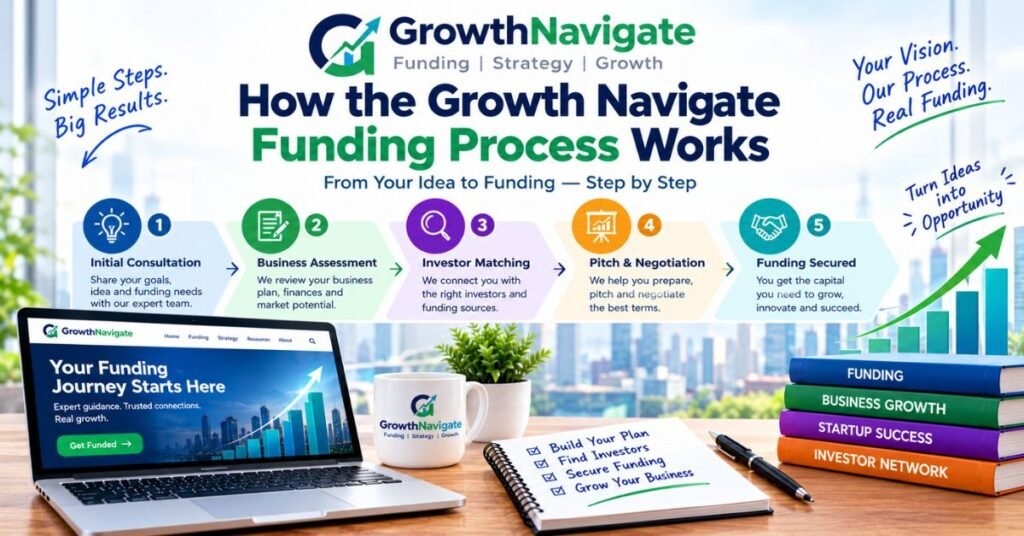
The Growth Navigate Funding fundraising process follows four clear steps. Each step builds on the last. This staged path beats scattershot outreach every time. You always know what comes next. You also know what you need to deliver. That clarity saves weeks of stress.
Steps involved in raising business capital differ by round and market. Still, the pattern holds. The table below shows a typical flow. Timelines vary, so treat them as a guide.
| Step | Main Activities | Output |
| 1. Discovery | Founder interview, market review, goal setting | Fundraising roadmap |
| 2. Positioning | Deck, model, narrative | Investor-ready materials |
| 3. Outreach | Targeting, intros, meetings | Active investor pipeline |
| 4. Close | Term sheet review, negotiation | Signed deal |
Discovery and Fundraising Strategy
Every strong raise begins with a deep talk. The team learns your story, your market, and your goals. Next comes an investment readiness assessment. It shows what’s strong and what needs work before you meet anyone. You review your traction, your team, your numbers, and your legal setup. Then you set targets for the round size, the timing, and the investor type. The result is a custom roadmap for your startup funding process. It explains how to secure funding for a startup step by step. You also learn how to prepare a business for investment. Nothing gets rushed. A good start saves you from costly detours later.
Pitch Deck Preparation and Business Positioning
Next, the team builds your materials. First comes the story. Why does your company matter? Why now? Then comes the investor pitch deck, paired with a tested financial model. Positioning follows. You decide how to present your strengths against rival firms. You also prepare the investment documentation investors expect.
This is the stage where preparing financial documents for investors turns messy files into clean, clear packets. Every number must match across the deck, the model, and the data room. Even small gaps cost trust. Consistent materials help improve investor confidence before the first call.
Investor Outreach and Relationship Building
Now the plan meets the market. The team picks a target list and sequences the outreach. Warm introductions come first. Then come meetings. Preparation matters here, so you learn how startups prepare for investor meetings with practice runs and mock questions. Strong investor outreach and engagement strategies keep each conversation moving.
This is also where you learn how to approach venture capital firms with respect and clarity. After each meeting, you follow up fast. You send the data asked for. You share news as it happens. Steady investor communication turns a polite maybe into a real yes. Patience helps. Most good deals take several touches.
Funding Closure and Business Growth
At last, offers arrive. A term sheet lists the main deal terms, such as price, ownership, and board seats. Review it with care. Price matters. So do control rights and liquidation terms. Advisors help you compare offers and negotiate fair terms. Then legal teams finalize the paperwork, and the money moves.
Yet the work continues. Support after close covers business growth planning, board reporting, and measuring fundraising performance against your plan. This focus supports sustainable business growth rather than a short-lived spike. Investors back companies that keep delivering. So keep your promises.
Growth Navigate Funding Statistics and Key Metrics
Numbers help you judge any fundraising partner. The company site reports $450M+ in capital secured, 300+ startups funded, 1,000+ investor relationships, and a 92% funding success rate. These are company-reported figures. Always ask for definitions and time frames.
What counts as “success”? A signed term sheet? A closed round? Over which years? Clear answers separate honest partners from flashy ones. Do the math as well. Spread across 300 startups, that capital averages about $1.5M each. That fits many early rounds. It’s smaller than a typical large round.
Use the table below to check any advisor’s claims. Then compare them with market data from sources such as Carta, Crunchbase, and PitchBook. Those platforms track round sizes, valuations, and funding trends worldwide.
| Metric | What It Means | How to Verify |
| Capital secured | Total money raised for clients | Ask for a client-approved breakdown |
| Startups funded | Number of closed rounds | Request references |
| Investor network size | Active relationships | Ask for investor types and regions |
| Success rate | Share of clients that closed | Ask for the formula and the period |
| Time to close | Weeks from launch to deal | Compare with market norms |
Who Can Benefit From Growth Navigate Funding?
Many kinds of teams gain from expert help. First-time founders gain the most from a guide. Tech startups need speed and sharp positioning. Scale-ups need larger rounds and stronger investment strategy. Small and mid-size firms need business financing options for hiring, equipment, or new markets.
This is the heart of funding opportunities for entrepreneurs around the globe. Funding readiness for small businesses matters just as much as it does for tech firms. A bakery chain and a software company both need clear numbers and a credible plan. Each also needs a believable story.
Fit depends on stage. Here’s a simple check.
| Stage | Typical Need | Main Support |
| Pre-seed | Story and first plan | Startup capital planning |
| Seed funding | Deck, model, first investors | Fundraising support for startups |
| Series A funding | Traction proof and strong metrics | Model, outreach, diligence |
| Series B and C | Scale and larger checks | Business expansion funding |
Some teams should wait. If you have no product and no early users, you may not be ready. Build proof first. Then raise. Investors pay for evidence, not just ideas. A startup investment readiness checklist can show what to fix before you begin. It usually covers your product, your numbers, your team, and your legal records.
Why Choose Growth Navigate Funding?
Picture a co-pilot who reads the weather before takeoff. That’s the value of an end-to-end partner. You get business funding and investment advisory from first idea to final signature. You also get strategic financial planning that keeps working after the round. One team handles the strategy, the materials, the introductions, and the follow-through.
You don’t juggle five freelancers. This is how fundraising consultants help startups save time and avoid common errors. The firm also offers business growth advisory and funding support, so your plan doesn’t end at the bank deposit.
Founders say it helps. “We closed our Series A in under 12 weeks with three term sheets on the table,” said James Carter, CEO of VentureCore, on the company site. Sarah Mitchell, founder of AlphaScale, added that the team “built our entire approach from scratch.” Treat testimonials as a starting point. Ask for references you can call yourself. Then compare your options below.
| Factor | Advisory Partner | Freelancer | Going Solo |
| Cost | Higher | Medium | Lowest upfront |
| Speed | Fast | Varies | Slow |
| Investor access | Broad | Limited | Small |
| Risk of errors | Lower | Medium | Higher |
| Post-close help | Often included | Rare | None |
Be wary of any firm that guarantees funding. No one can. Look for clear fees, honest timelines, and written terms. Transparency is a good sign. Hype is not.
Frequently Asked Questions
What Is Growth Navigate Funding?
Growth Navigate Funding is an advisory firm that helps startups and businesses raise capital. It offers fundraising strategy, pitch deck development, investor outreach, financial modeling services, and due diligence preparation. It also supports growth after the round closes.
Which Services Does Growth Navigate Funding Offer?
The core services include fundraising consulting, investor relations services, growth strategy consulting, and capital acquisition support. You also get help with investment documentation and investor communication. Together they cover the whole startup funding process.
Who Is Growth Navigate Funding Best For?
It suits first-time founders, tech startups, scale-ups, and established small firms. Any team with a real product and early proof can benefit. Teams with no product should build traction first.
How Long Does a Fundraising Round Usually Take?
Most rounds take several months. Timing depends on your stage, your market, and how ready your materials are. Good preparation shortens the road. Rushed preparation lengthens it. Plan for delays and keep cash in reserve.
Does Growth Navigate Funding Guarantee Investment?
No. No honest advisor can guarantee funding. Investors make their own choices. A good partner improves your investment readiness and your odds. The final decision always belongs to the investor.
How Much Does It Cost to Work With a Fundraising Advisor?
Fees vary by scope and region. Some firms charge monthly retainers. Others charge success fees or a mix. Ask for a written fee plan before you sign. Also ask what happens if the round doesn’t close. Clear answers prevent painful surprises.
Start Your Growth Navigate Funding Journey
Raising money is hard. Yet a clear plan makes it far less scary. With the right funding advisory services, you move from guesswork to a staged path. You build a sharp deck. You back it with sound numbers. You meet the right investors. And you grow with purpose after the check clears.
Ready to take the first step? Book a consultation with Growth Navigate Funding and map your route to sustainable business growth.

StyleXMag Editorial Team shares the latest haircut and hairstyle ideas, from modern fades and comb overs to curly, long, slick-back, and face-shape styles. Our goal is to make finding your next look simple, useful, and inspiring.