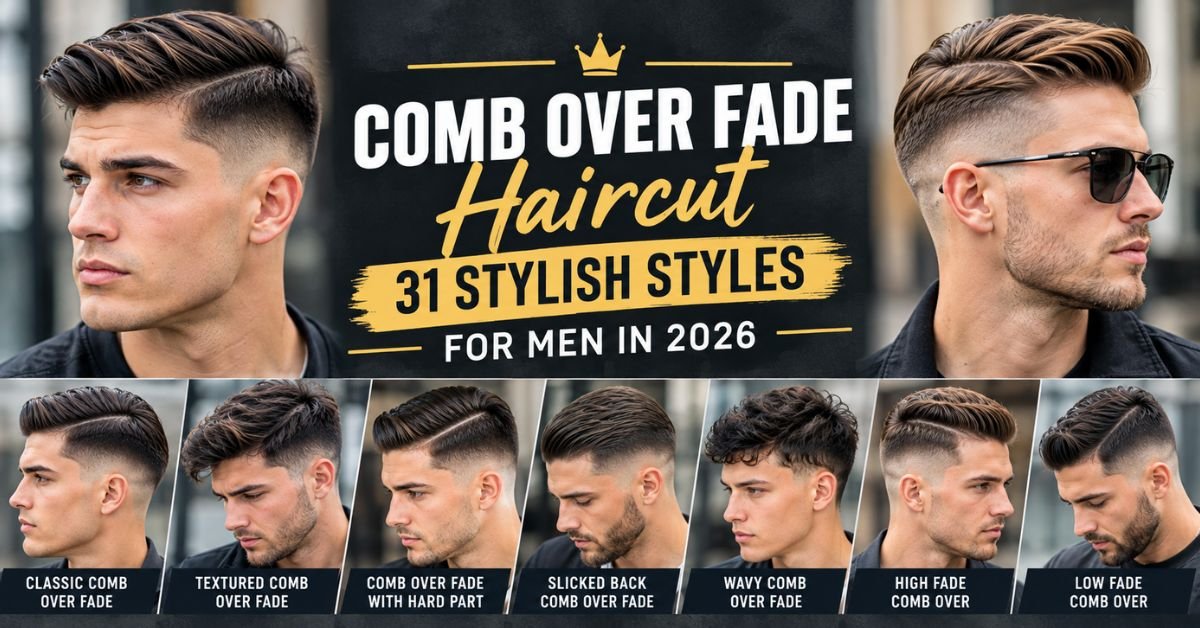
Comb Over Fade Haircut: 31 Stylish Styles for Men in 2026
Some haircuts come and go. The comb over fade haircut for men sticks around. Barbershops in every country keep it on the menu because it looks sharp on almost everyone. You get a neat top, clean sides, and a shape that works at the office or on the weekend. This guide covers 31 comb over fade styles, with barber phrases, styling steps, and upkeep tips.
You don’t need special skills to wear this cut. You only need a clear plan and a good barber. Read on, pick your favorite, and walk into the shop with confidence. Here’s the short version.
What Is a Comb Over Fade Haircut?
A comb over fade haircut keeps longer hair on top and sweeps it to one side. The short sides and back fade down from longer to shorter. The result is a side-swept hairstyle with a defined hair part and a clean neckline. It’s a modern comb over haircut built on a very old idea. Men have combed their hair sideways for over a century.
The fade is what makes it new. A plain comb over can look flat or dated. Add a blended fade, and the top pops against the sides. That contrast gives the cut its edge. The fade level also sets your upkeep. A high fade shows regrowth fast, while a taper fade ages slowly. Here’s how the two main options differ.
| Feature | Fade | Taper |
| Length at the base | Can reach bare skin | Always keeps some hair |
| Contrast | Strong | Soft |
| Grow-out | Shows a line fast | Grows out gracefully |
| Best for | Bold, sharp looks | Conservative, easy upkeep |
| Barber visits | Every 1 to 3 weeks | Every 4 to 5 weeks |
Best Comb Over Fade Haircut Styles
Every entry below follows the same pattern. You’ll see what makes the style special and who it suits. You’ll also get an exact phrase for your barber and an upkeep schedule. Think of it as a menu with the ordering instructions already written. These comb over haircut styles fit men’s hairstyles at every age.
Read More: How To Style Slick Back Haircut: Easy Steps for a Perfect Look
Pay attention to the “best for” notes as you read. They connect each cut to your face shape, hair type, and hair density. The table below gives you a fast overview. If a style catches your eye, jump to its section for the full story.
| Style | Best Face Shape | Upkeep |
| Low fade | All shapes | Every 3 weeks |
| Mid fade | All shapes | Every 2 to 3 weeks |
| High fade | Round | Every 1 to 2 weeks |
| Skin fade | All shapes | Every 1 to 2 weeks |
| Taper fade | Oblong, long | Every 4 to 5 weeks |
| Burst fade | Oval, round | Every 2 to 3 weeks |
| Hard part | Oval, square | Every 2 weeks |
| Pompadour | Round, square | Every 2 to 3 weeks |
Low Fade Comb Over
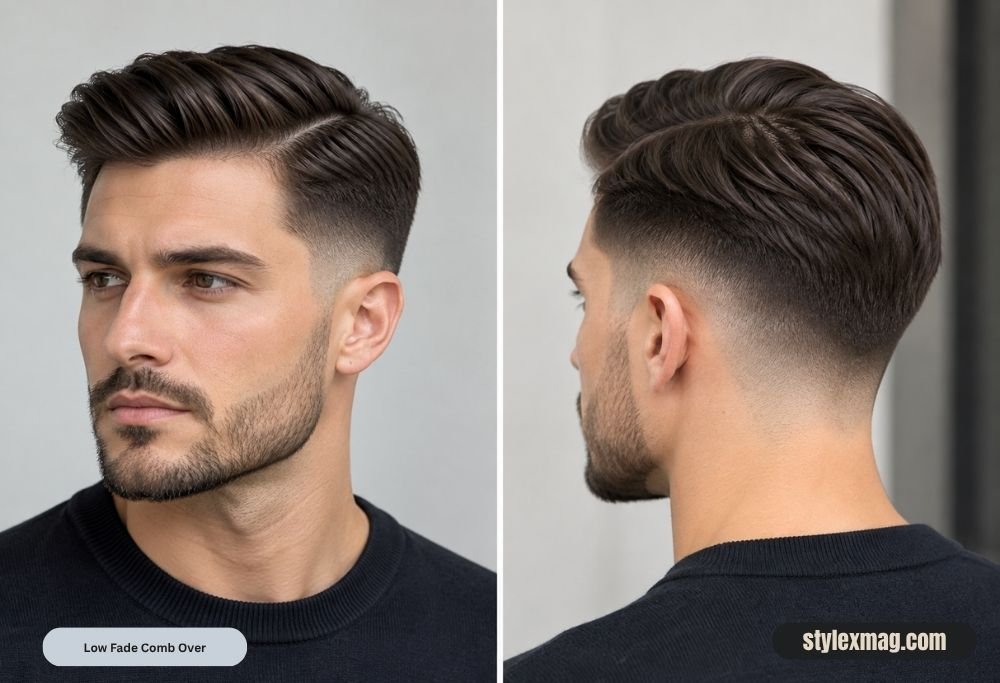
The low fade comb over starts the fade just above the ear. The sides stay fairly full, so the contrast feels soft. It’s the ideal first step for men who’ve never tried a fade haircut. Offices love it because it looks tidy and calm. It also holds its shape between visits. This low fade haircut suits every face shape, and oblong faces gain the most. Tell your barber: “Low fade comb over, starting just above the ear, natural side part, blended clean.” Book a trim every 3 weeks.
Mid Fade Comb Over
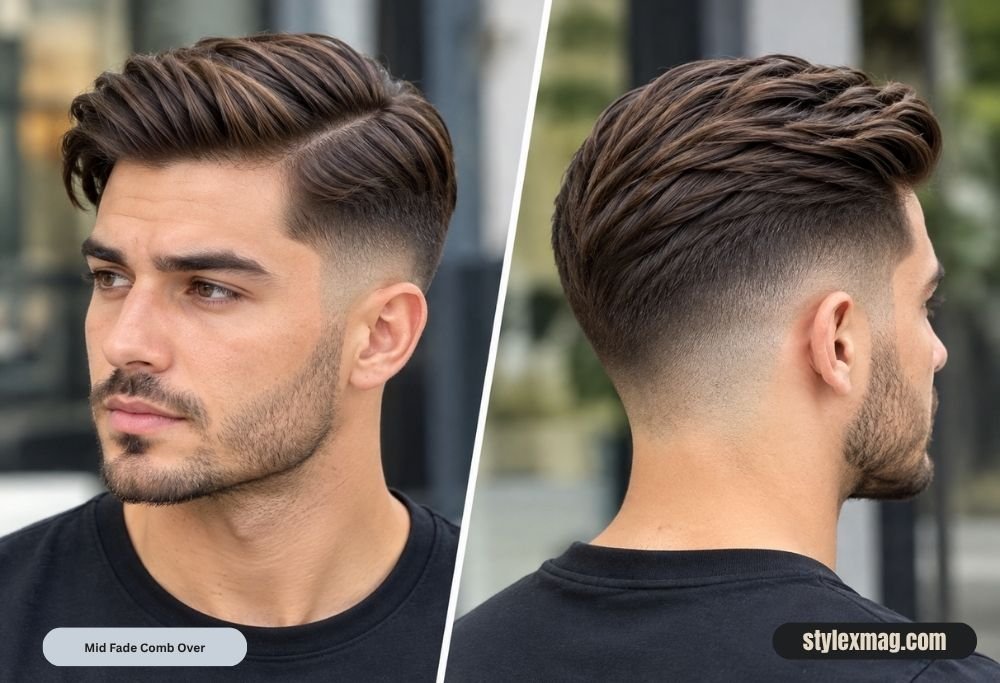
The mid fade comb over begins at temple level. It balances bold and safe better than any other option. Most men picture this cut when they say “comb over fade.” It works on every face shape and in nearly every setting. Many barbers call it the easiest sell in the shop. A mid fade haircut also gives you room to play with the top. Ask for it this way: “Mid fade comb over at the temple, natural or hard part, blended clean.” Plan on a visit every 2 to 3 weeks. Search for mid fade haircut men ideas, and you’ll see this cut everywhere.
High Fade Comb Over
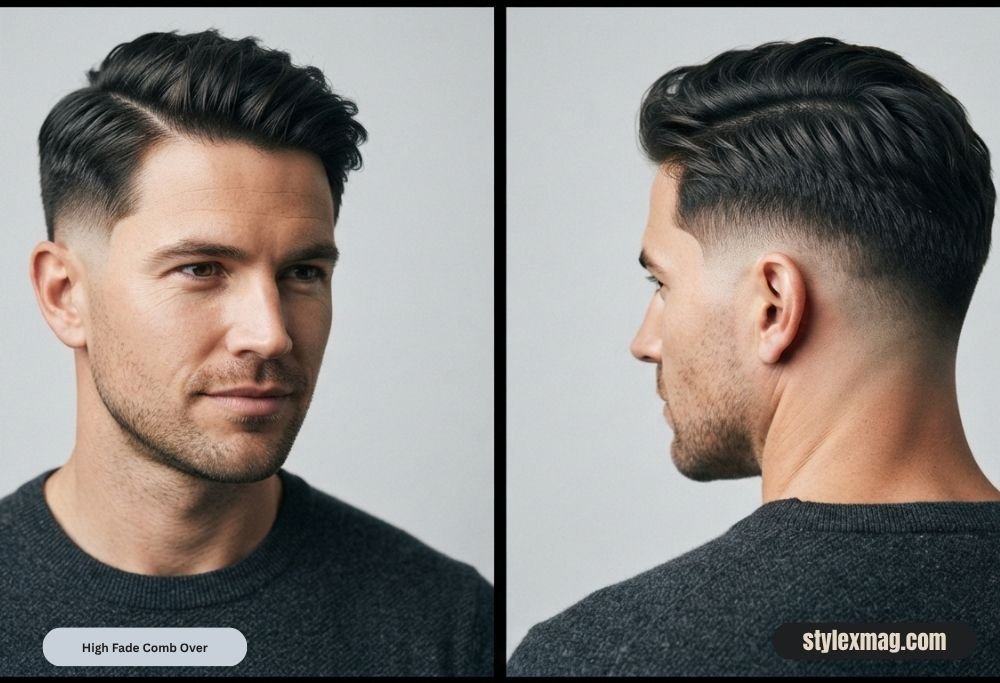
The high fade comb over starts above the temples. The sides go very short, so the top looks even fuller. This cut loves thick hair because the density earns the strong contrast. Round faces also benefit, since the height adds visual length. Conservative workplaces may frown on it. Say this at the chair: “High fade comb over, above the temples, tight on the sides.” Expect a trim every 1 to 2 weeks. High fades lose their crispness fast.
Skin Fade Comb Over
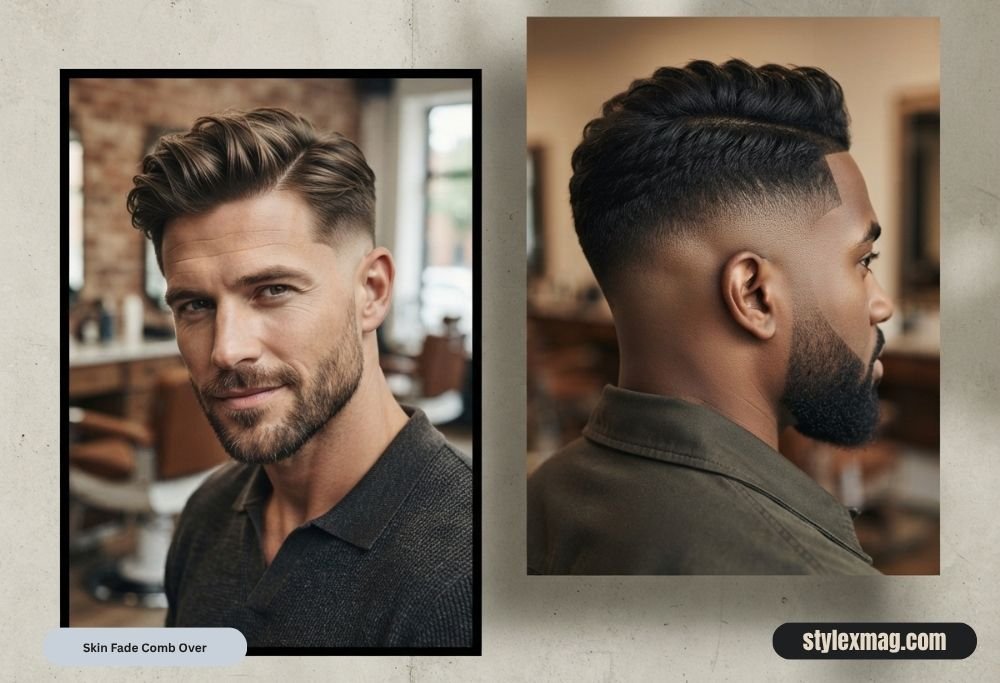
The skin fade comb over takes the base down to bare skin. Your barber finishes with a straight razor for a sharp edge. The skin fade can sit low, mid, or high. Some call this a bald fade because the skin shows through. Skill matters more here than in any other version. A careless blend leaves patches and harsh lines. Ask clearly: “Skin fade comb over, bald at the base, razor finish, mid height.” Book every 1 to 2 weeks to keep it fresh.
Taper Fade Comb Over
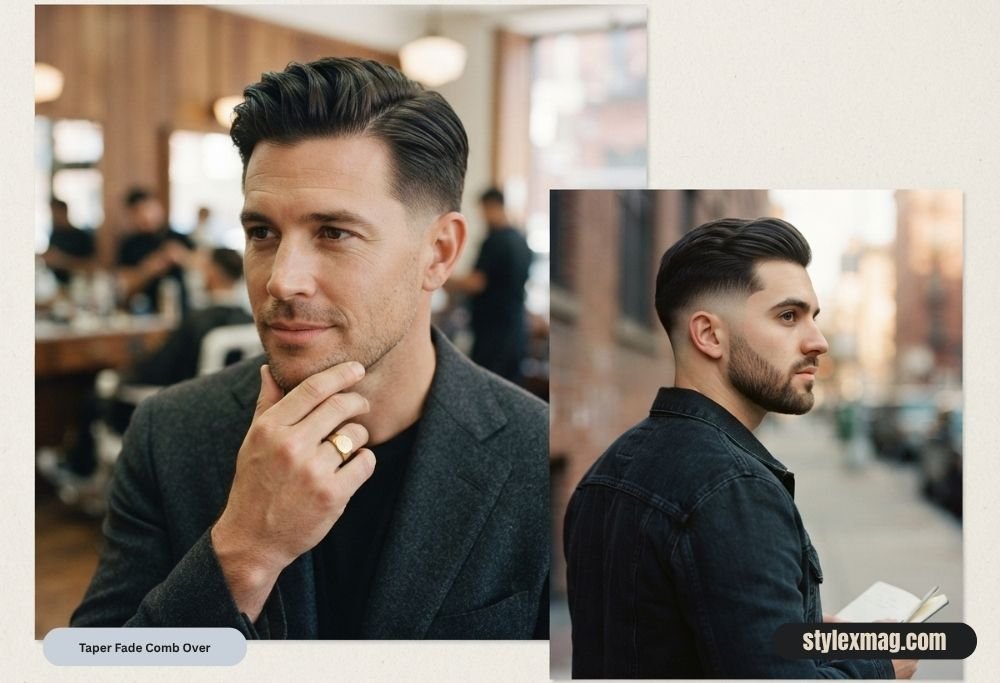
The taper fade comb over shortens toward the neckline but never hits skin. That makes it the calmest version of the group. Tapered sides grow out with grace, so nobody notices a slightly late trim. A low taper fade at the neck and ears gives a classic, gentle finish. It suits oblong faces, thin hair, and fine hair. Try this line: “Comb over taper fade, keep some hair at the base, don’t go to skin.” A visit every 4 to 5 weeks is plenty.
Drop Fade Comb Over
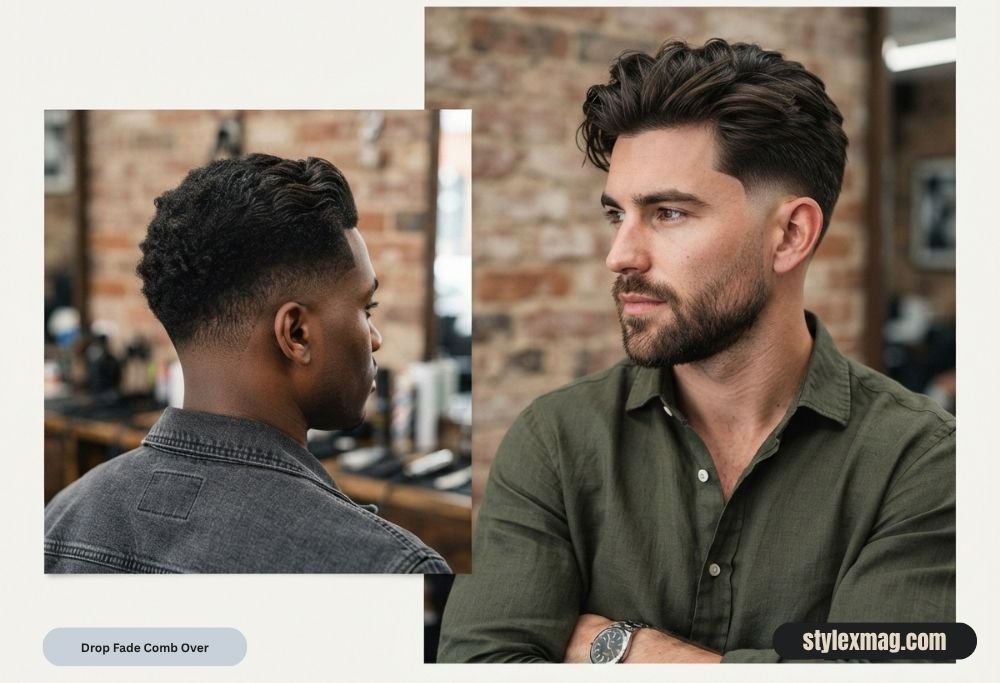
The drop fade comb over runs straight on the sides. Then the line curves down behind the ear. From the front, it looks like a normal fade. From the back, you get a sculpted shape. That extra curve adds quiet drama. It works at any height and flatters oval and round faces. Tell your barber: “Drop fade comb over, let the fade line curve lower at the back.” Return every 2 to 3 weeks.
Burst Fade Comb Over
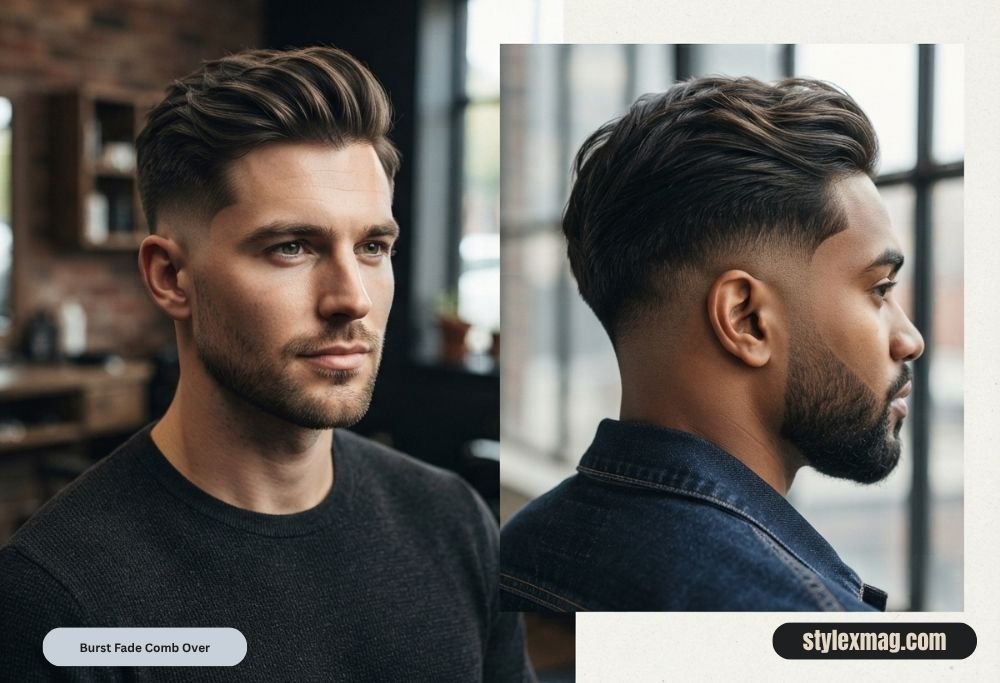
The burst fade comb over wraps in a half-circle around the ear. The hair at the back stays longer. A burst fade follows the shape of your head, so it flatters curly hair and wavy hair. The arc moves with your natural growth pattern instead of against it. Say: “Burst fade comb over, curved arc around the ear, leave more length at the back.” Visit your barber every 2 to 3 weeks.
Temple Fade Comb Over
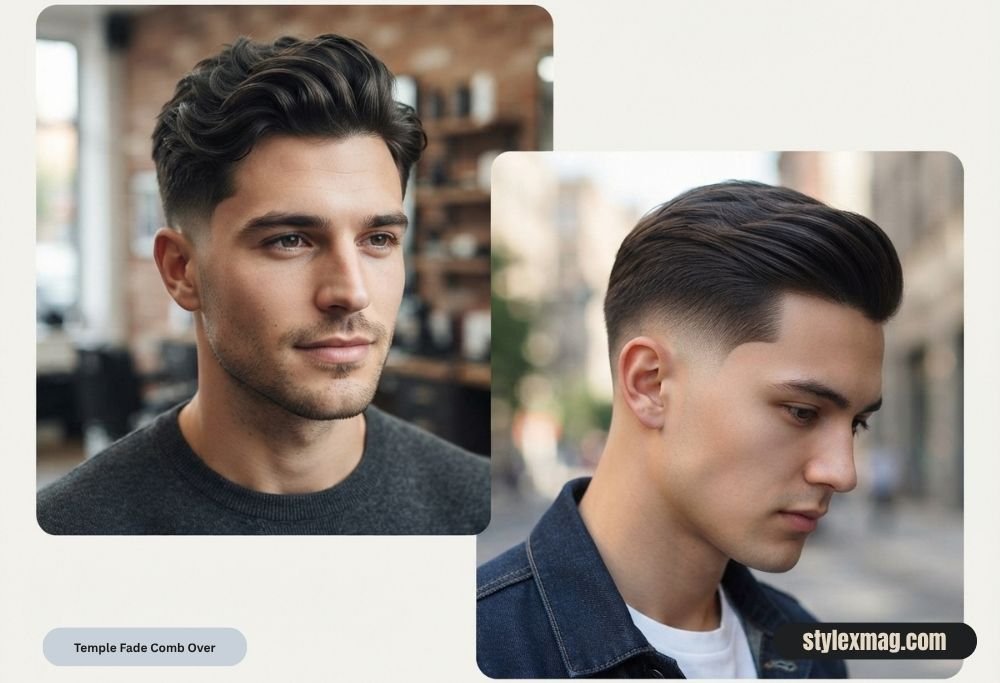
The temple fade comb over focuses the fade around the temples and front hairline. The back and upper sides stay fuller. Many men add a lineup for extra front sharpness. Short tops show this cut best, because the front detail does the work. It suits every face shape. Ask for it like this: “Temple fade comb over, tight around the temples and hairline, fuller at the back, add a lineup.” Trim every 2 to 3 weeks.
Short Comb Over Fade
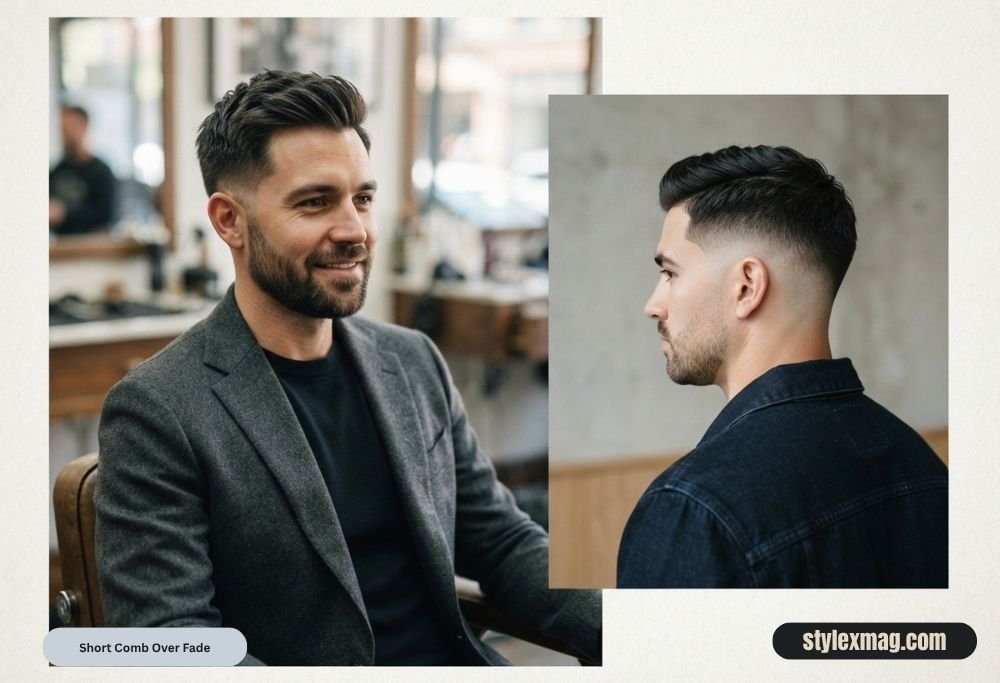
The short comb over fade keeps the top at 1 to 1.5 inches. That’s the shortest length that still holds a side direction. You won’t get big volume, but you’ll get a neat, structured look. Styling takes seconds. A dab of pomade or matte clay holds the direction without weight. It works on every hair type. Tell your barber: “Short comb over fade, top at about an inch, low or mid fade, side part.” The fade still needs a trim every 2 to 3 weeks.
Medium-Length Comb Over Fade
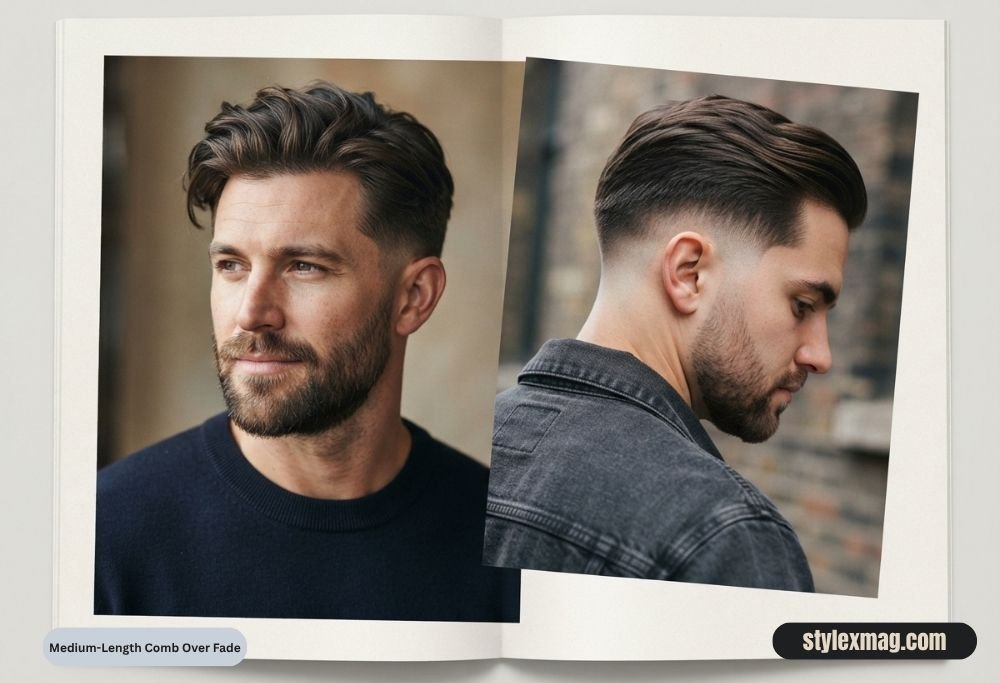
The medium-length version keeps 2 to 3 inches on top. It’s the most popular length for good reason. You get texture, lift, and a clear sweep without much effort. Most hair styling products work well at this length. Paired with a mid fade, it fits most faces and hair types. Say: “Comb over fade, top at 2 to 3 inches, mid fade on the sides.” Come back every 2 to 3 weeks.
Long Comb Over Fade
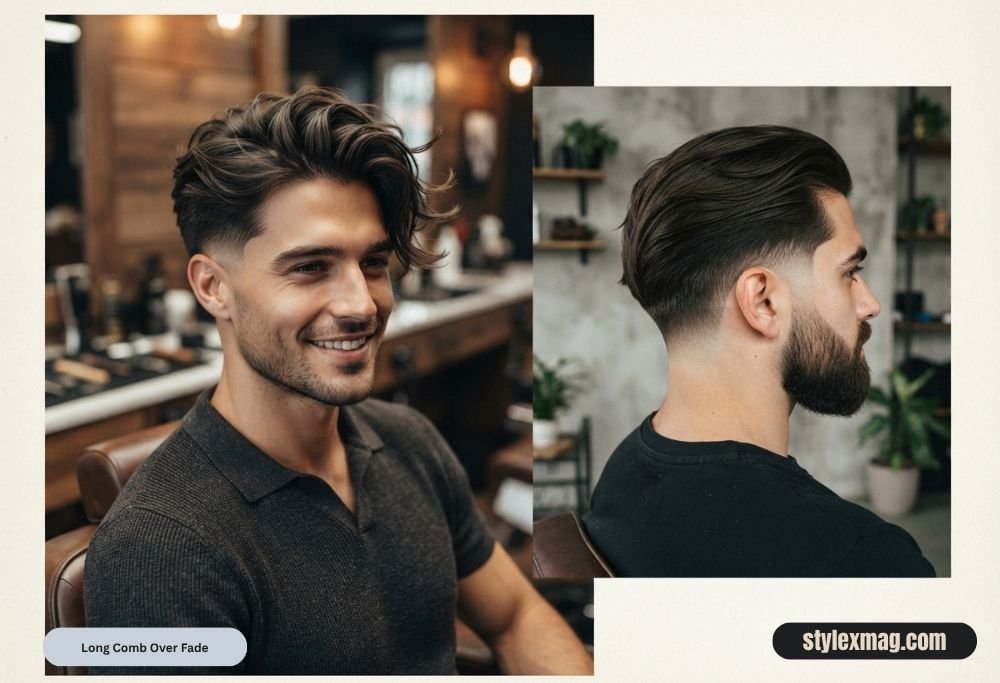
The long version leaves 4 inches or more on top. The hair flows dramatically to one side. A strong-hold product keeps the shape all day. A mid or high fade balances the length so the cut doesn’t look top-heavy. Wavy hair and thick hair add natural movement here. Ask for it like this: “Long comb over fade, leave the top long, mid fade on the sides.” Trim the sides every 3 to 4 weeks. Trim the top every 6 to 8 weeks.
Classic Comb Over Fade
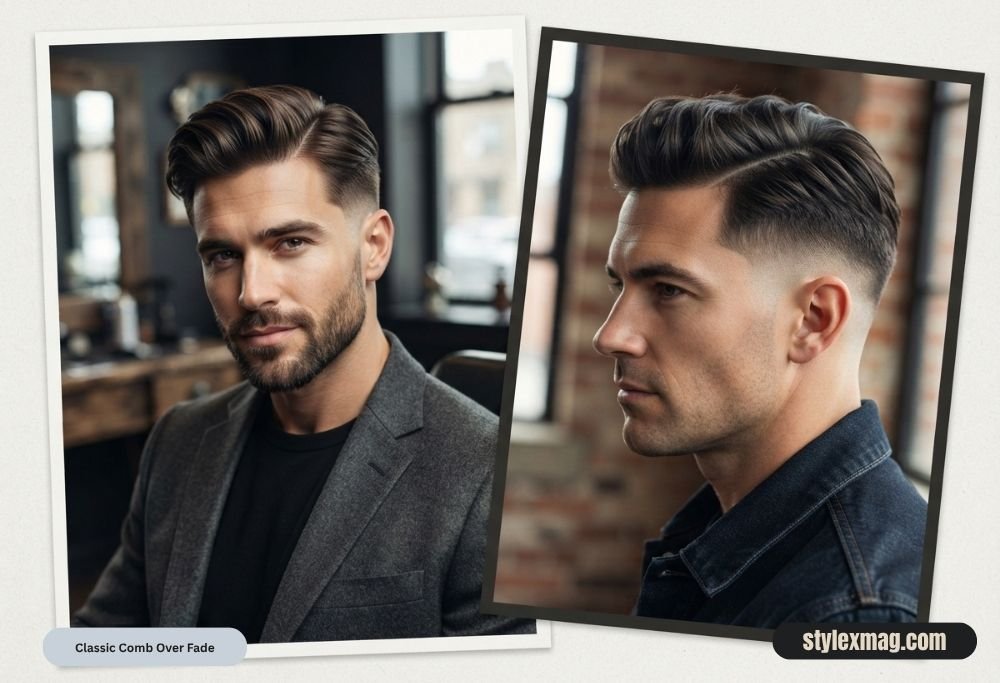
The classic comb over fade is the default cut. It has a natural side part, smooth hair across the top, and low-faded or tapered sides. The finish sits between slick and textured. It’s a classic men’s haircut that never looks out of place. A professional hairstyle like this works at any top length from 2 to 4 inches. Tell your barber: “Classic comb over fade, natural side part, medium hold, blended sides.” Visit every 3 weeks.
Textured Comb Over Fade
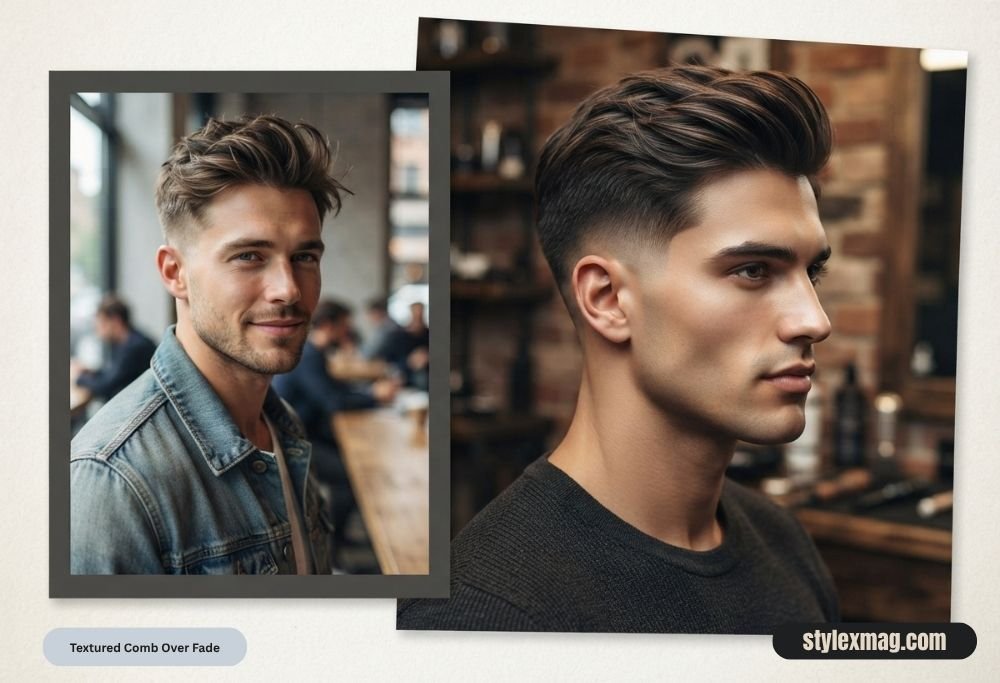
The textured comb over fade trades shine for movement. Your barber point-cuts the ends so the hair looks choppy and alive. A textured top finished with matte clay looks relaxed and current. This style suits wavy hair and thick hair, where a flat finish is hard to keep. Ask: “Comb over fade, textured finish on top, point cut the ends, matte product.” Book every 3 weeks. It’s also a fine casual hairstyle for weekends.
Slick Comb Over Fade
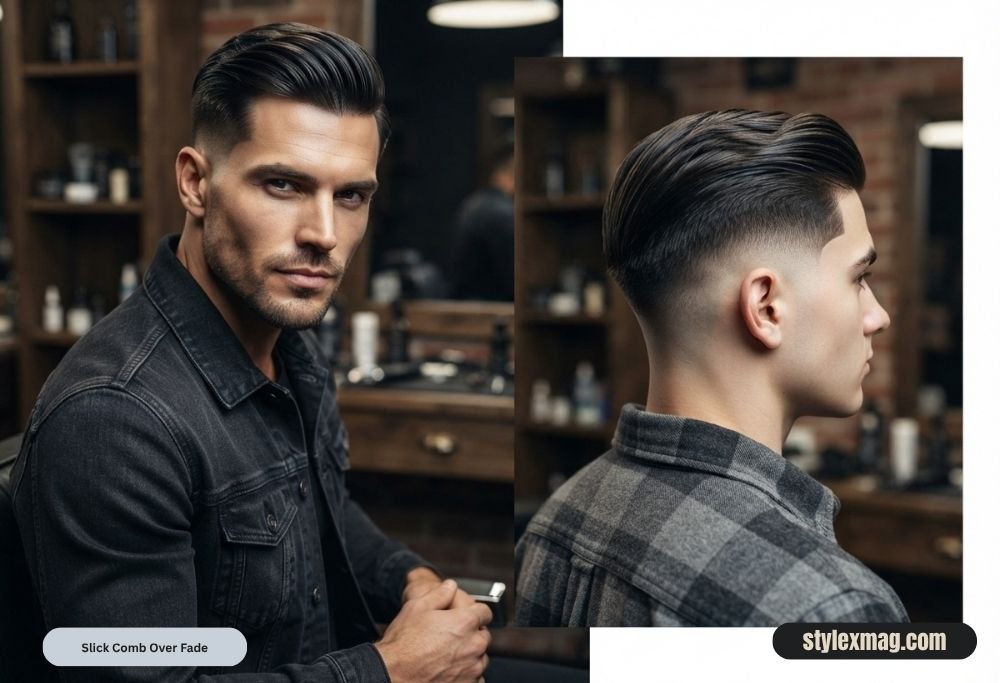
The slick version presses every strand flat with heavy pomade. It shines like a mirror. You’ll see fine comb lines in the hair. It’s the most formal choice in the lineup. Only straight hair handles it well, since waves and thick strands fight the flat finish. Pair it with a low fade or taper for balance. Say: “Low fade comb over, slick finish on top, I’ll style it flat with pomade.” Trim every 3 weeks.
Hard Part Comb Over Fade
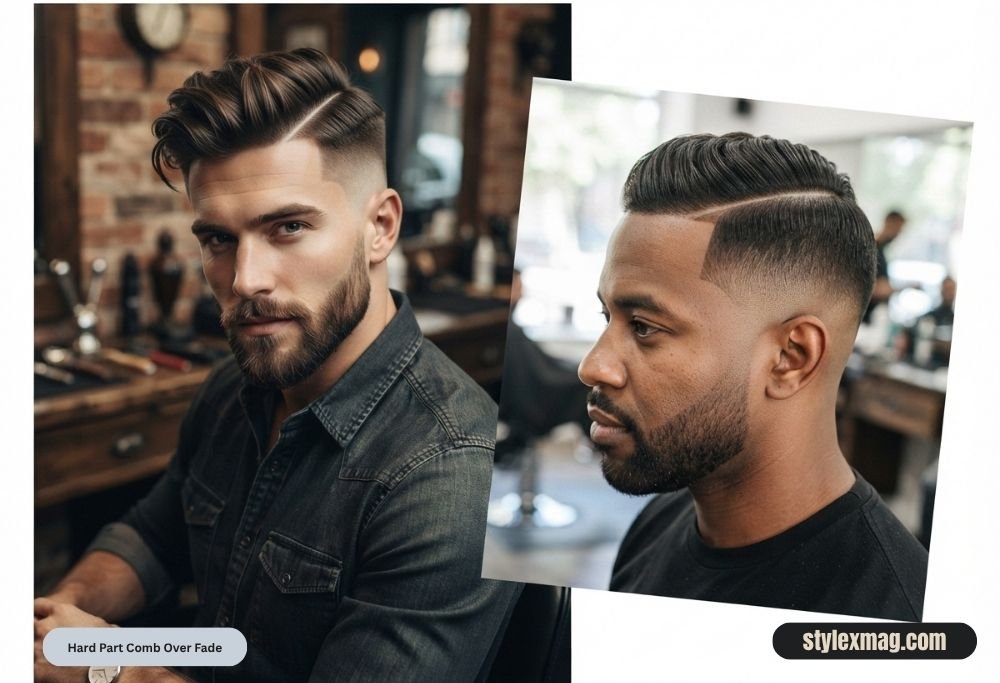
The hard part comb over fade adds a razor-shaved line where the hair parts. That thin line of bare scalp creates a very defined hair part. A hard part also keeps the direction steady between washes. It works at any fade height. However, the line grows in within about two weeks. Ask for it clearly: “Comb over fade, razor hard part on the left, about an inch back from the hairline.” Visit every 2 weeks for the part.
Disconnected Comb Over Fade
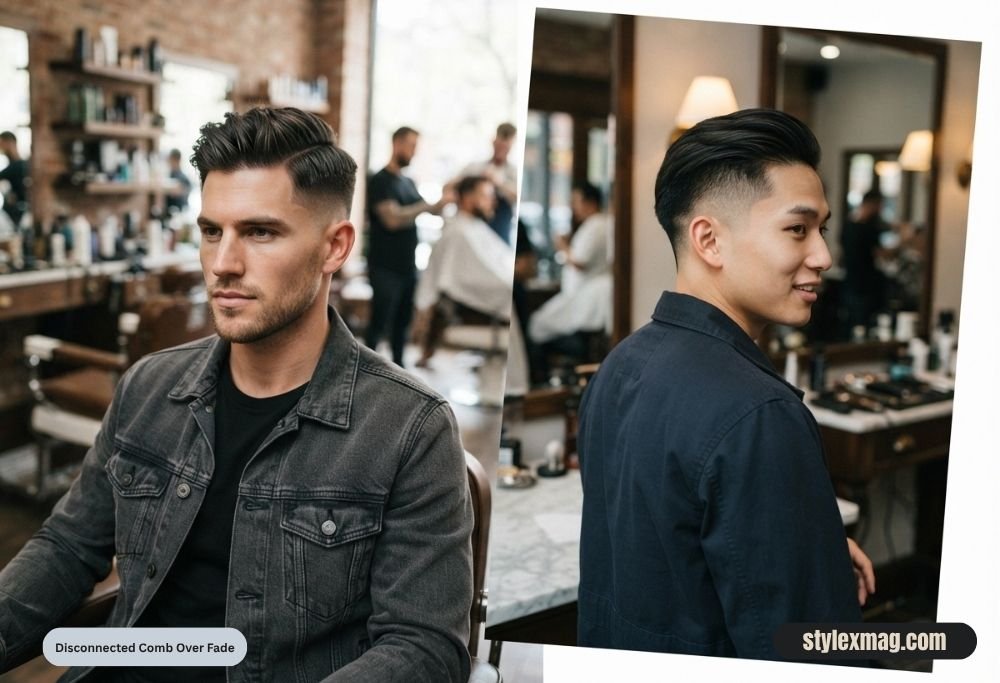
The disconnected style leaves a hard gap between the long top and the short sides. There’s no blending at all. The gap becomes the design. You need 3 to 4 inches on top so the split shows clearly. Straight hair gives the cleanest line. This structured hairstyle reads bold and modern. Tell your barber: “Disconnected comb over, hard line between top and sides, no blend at the transition.” Trim every 2 to 3 weeks.
Deep Side Part Comb Over Fade
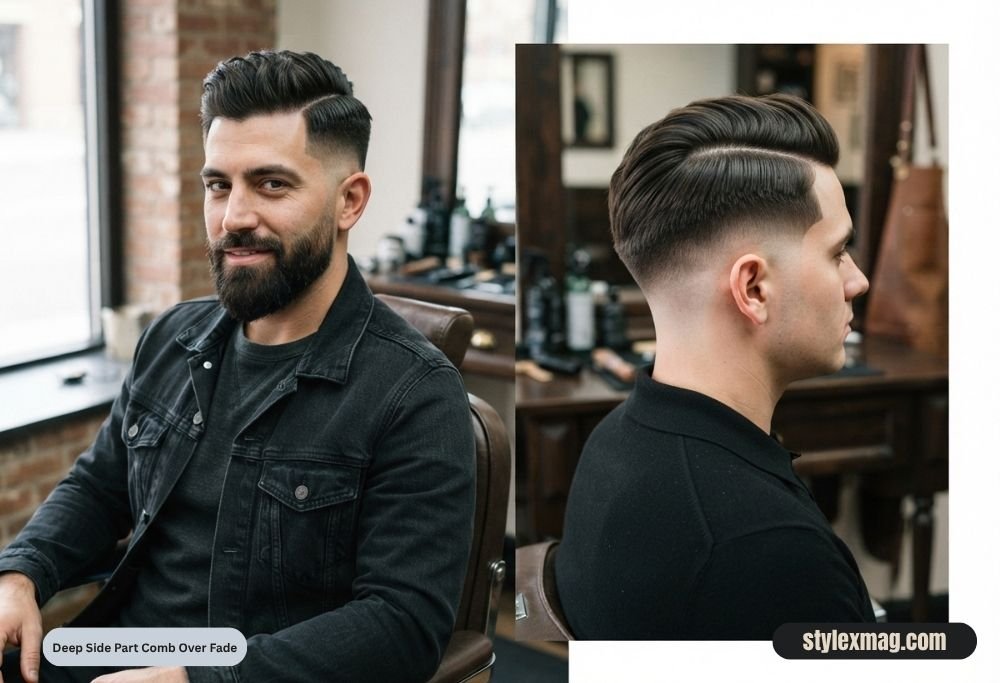
The deep side part sits far from the natural hairline. More hair crosses the top in a wide, dramatic sweep. That extra width makes long and oblong faces look shorter and fuller. Rectangular faces gain from it too. Ask for it this way: “Deep side part comb over fade, part further from the hairline than usual, mid fade on the sides.” Come back every 2 to 3 weeks. Straight and wavy hair both hold it well.
Comb Over Fade Pompadour
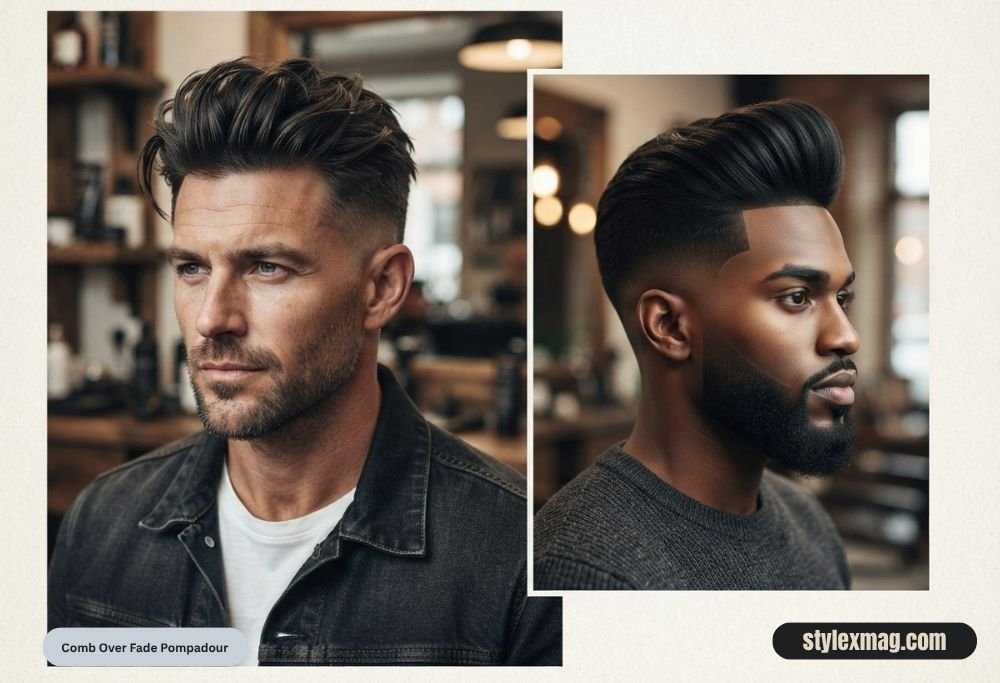
The comb over fade pompadour lifts the front up and back, then sends it sideways. You can see the height from the side as a ridge above the forehead. This voluminous top needs at least 3 inches and a strong-hold product. Round and square faces suit it best. Thick and wavy hair help too. Say: “Comb over pompadour fade, volume on top swept back and to the side, mid or high fade.” Trim every 2 to 3 weeks.
Comb Over Fade Quiff
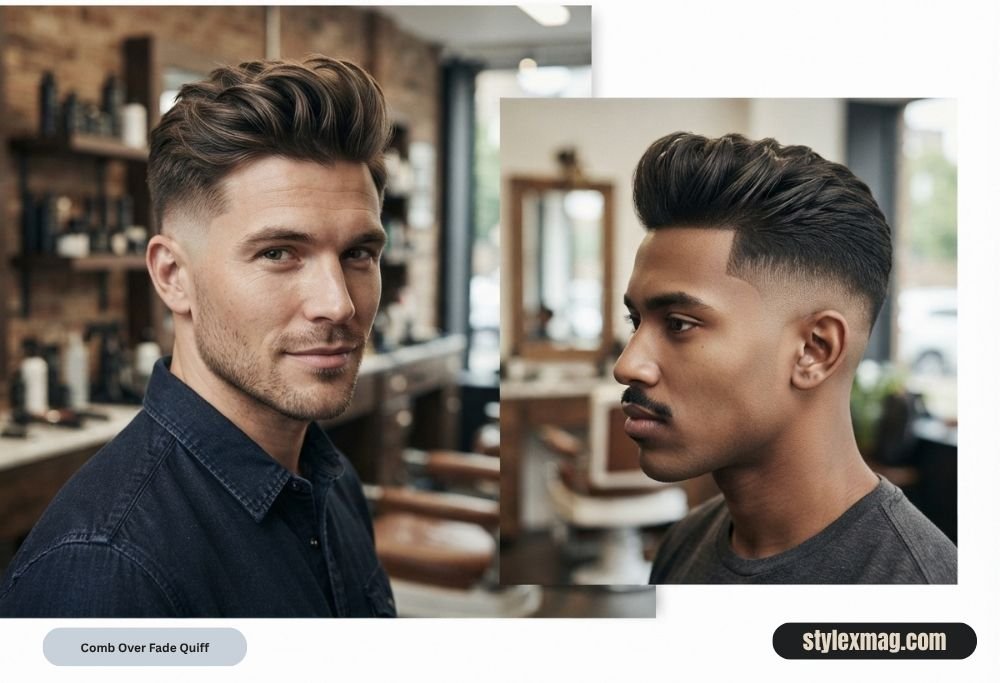
The comb over fade quiff pushes volume forward and slightly up at the front. Then it sweeps sideways. The forward lift adds structure at the hairline without going too tall. It flatters oval and round faces. Thick and wavy hair give it body. Ask: “Comb over quiff fade, volume at the front pushed forward and to the side, not swept back.” Return every 2 to 3 weeks.
Comb Over Fade with Hair Design
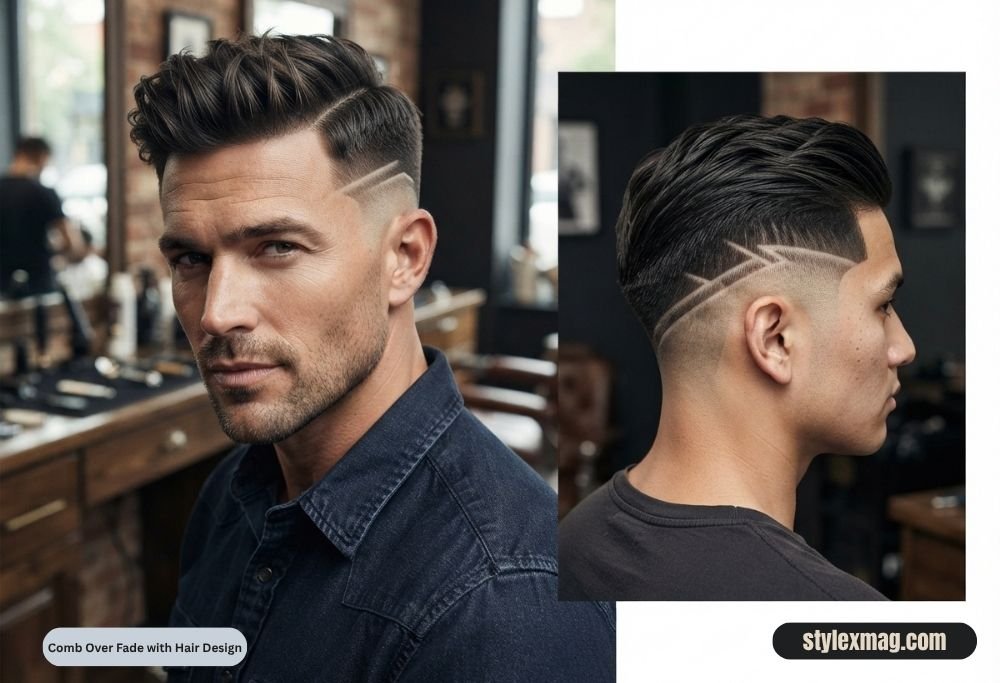
This cut adds shaved lines, curves, or patterns into the faded area. The comb over stays untouched on top. A mid or high fade gives your barber a bigger canvas. Only trust a barber who does razor art often. Designs blur faster than fades do. Tell your barber: “Comb over fade, mid or high fade, add [describe your design] in the faded area.” Plan a visit every 1 to 2 weeks.
Comb Over Fade with Beard
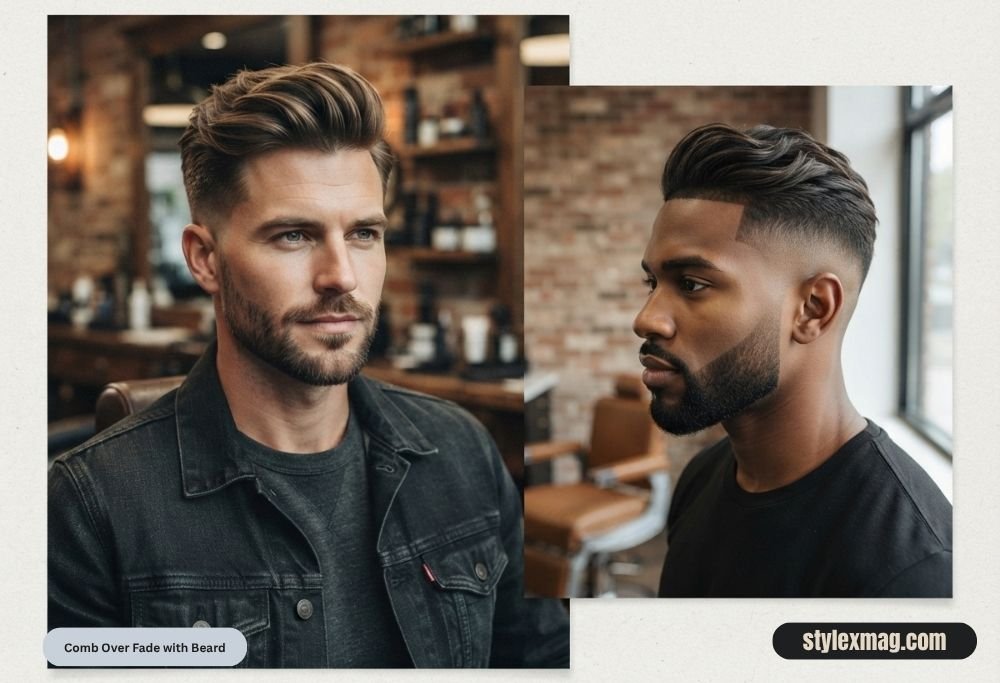
A comb over with beard looks polished when the fade flows into the whisker line. A mid fade starting at the temple drops down to the sideburn, then melts into the beard fade. Many barbers leave a gap unless you ask otherwise. The short boxed beard style works best here. It has neat edges, even length, and a clean cheek line. Say: “Comb over mid fade, connect the fade into my beard at the sideburn, no gap.” Visit every 2 to 3 weeks, and trim the beard at the same time.
Comb Over Fade with Stubble
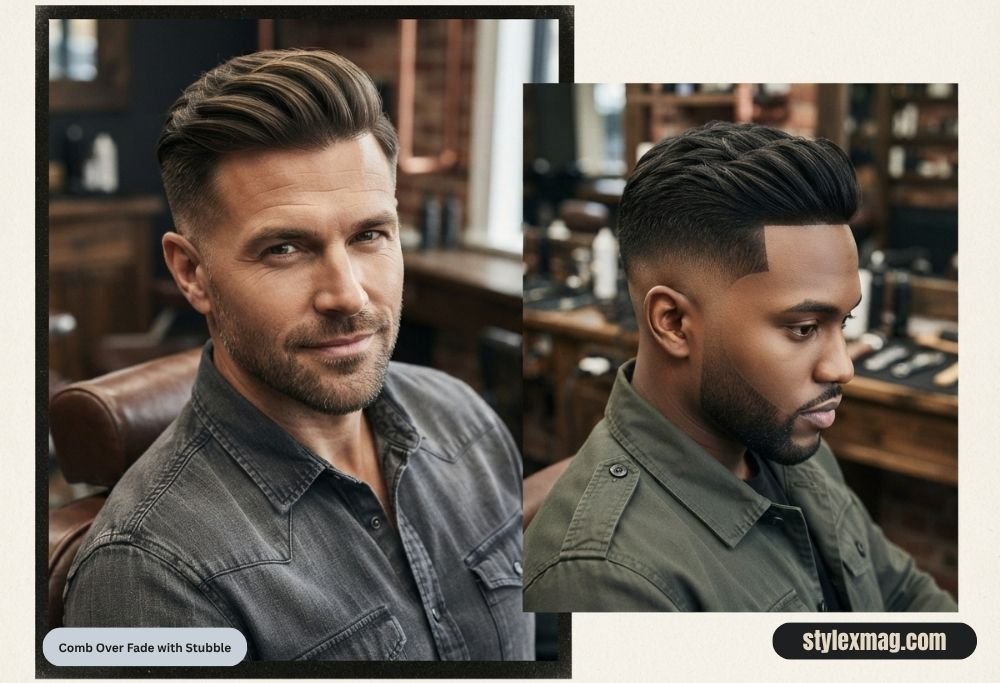
Three to five days of stubble adds jaw definition without a beard’s workload. A low or mid fade slides naturally into the stubble at the sideburn. The look works from the office to a night out. Keep the stubble edges crisp so it looks planned. Tell your barber: “Comb over fade, low or mid fade that transitions into stubble, keep the edges clean.” Trim every 3 weeks.
Comb Over Fade for Straight Hair
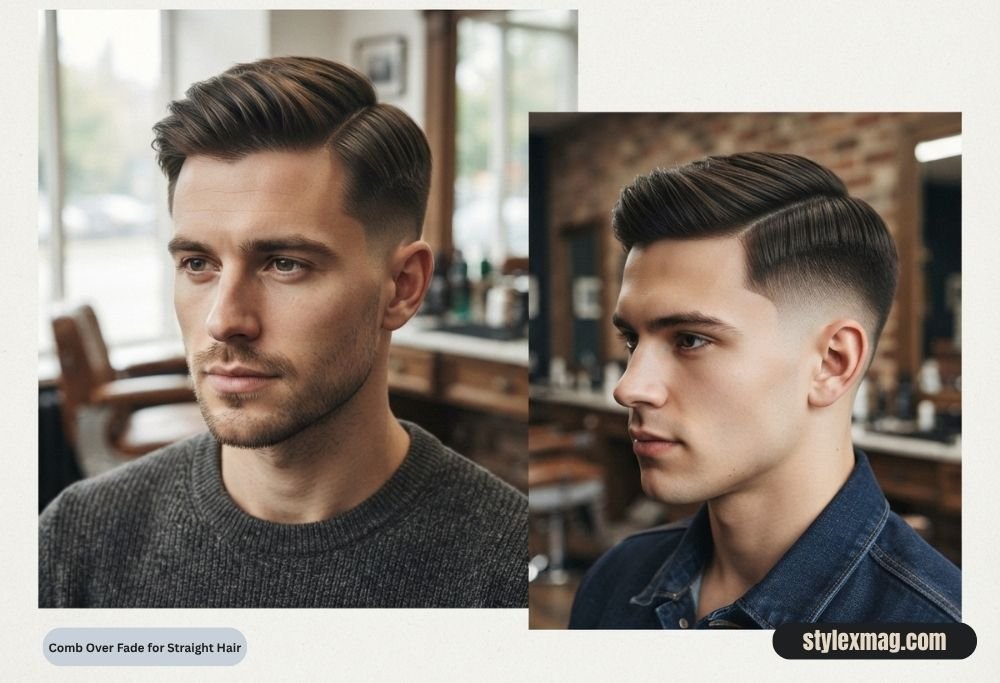
Straight hair gives the sharpest lines of any texture. The hard part and the fade both show clearly. The only risk is a flat top. Ask your barber to point-cut the ends instead of blunt cutting. That adds soft movement. Say: “Comb over fade, point cut the top, not blunt. I have straight hair.” Visit every 2 to 3 weeks.
Comb Over Fade for Wavy Hair
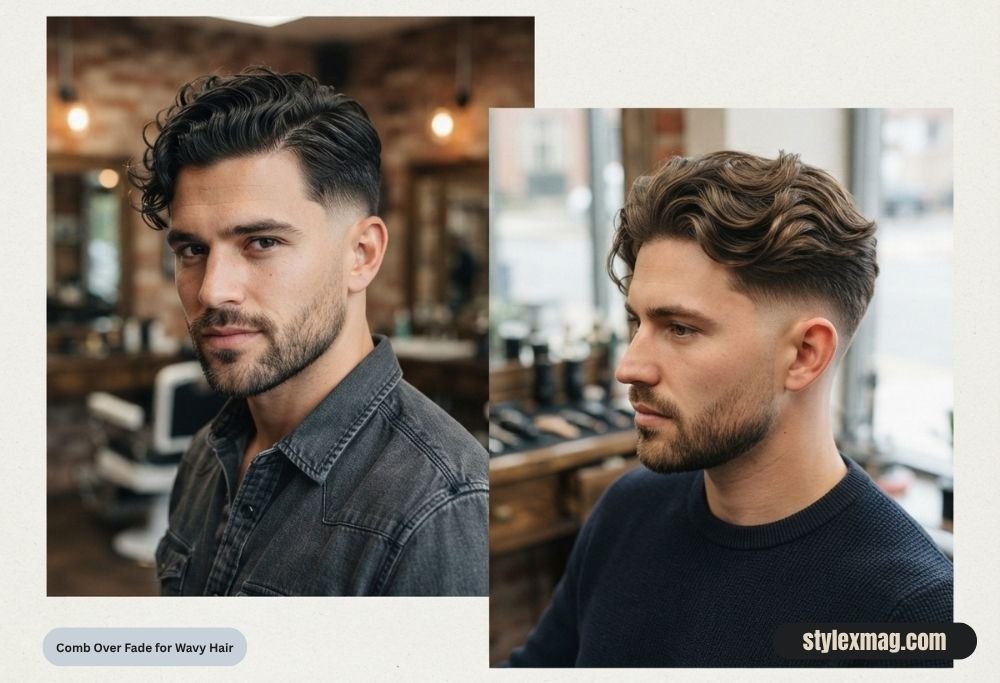
Wavy hair adds volume and motion with little effort. The textured version suits waves better than a slick finish does. Sea salt spray on damp hair boosts the natural pattern. Let the waves become part of the style. Tell your barber: “Comb over fade, textured finish to work with my natural wave.” Trim every 3 weeks.
Comb Over Fade for Curly Hair
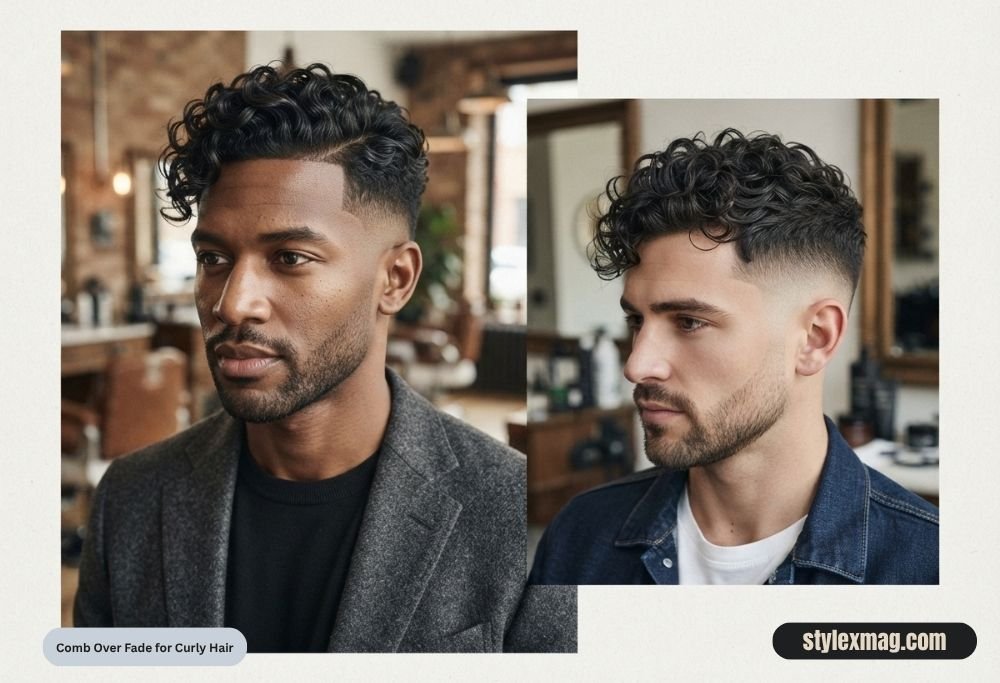
Curly hair needs a looser approach. Curls resist flat, slick styling. Let them stay visible on top, and guide them toward one side. Your barber can use scissor-over-comb on the sides for a soft blend. Leave-in conditioner keeps curls defined between washes. Say: “Comb over fade, loose direction on top, scissor-over-comb on the sides, keep my curl definition.” Also ask the barber to set the fade height on dry hair. Wet curls stretch and mislead the eye. Visit every 3 weeks.
Comb Over Fade for Thick Hair
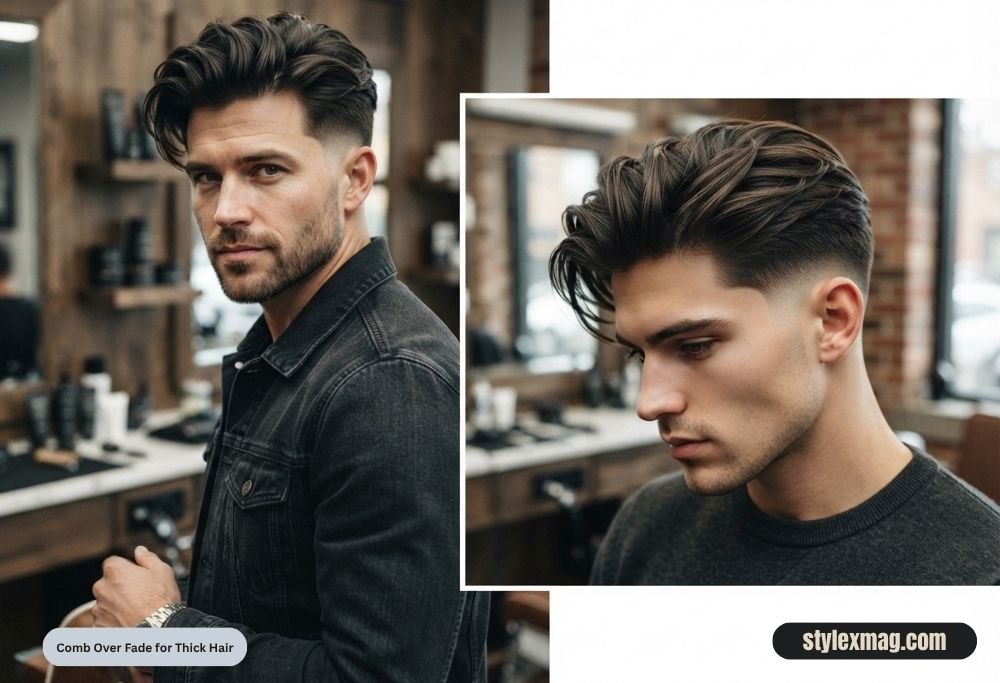
Thick hair holds a comb over direction beautifully. It also adds bulk at the sides. A mid fade strips that bulk and puts the focus on top. Point-cutting or texturizing the top lightens the weight. Matte clay grips dense hair better than pomade. Tell your barber: “Comb over fade, point cut or texturize the top to reduce weight, mid fade on the sides.” Square and round faces both look great in it. Visit every 2 to 3 weeks.
Comb Over Fade for Thin Hair
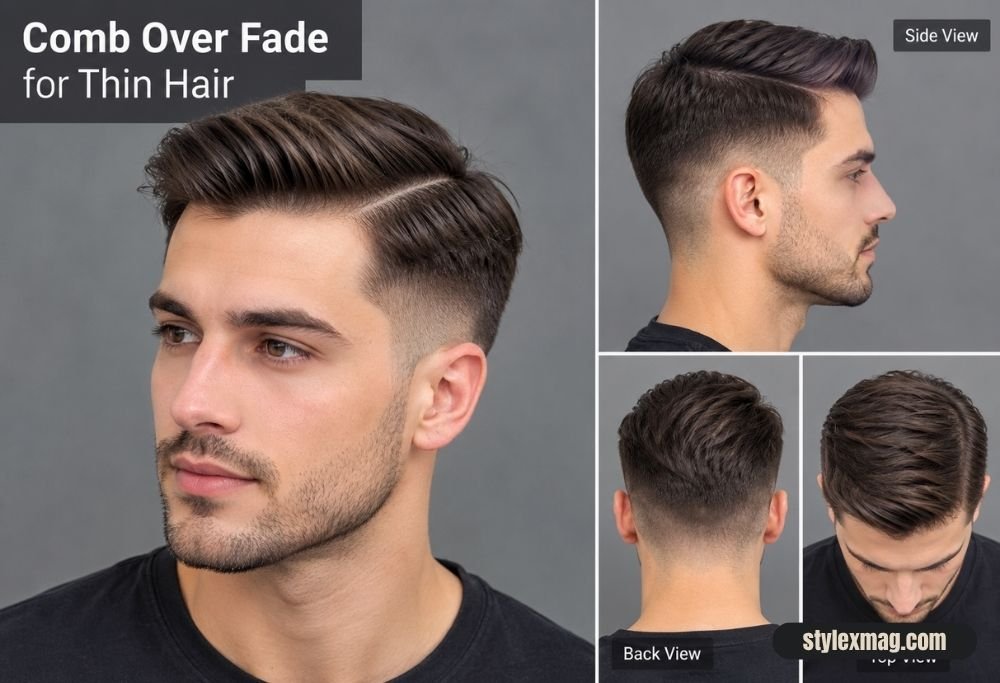
Thin hair can pull off a comb over fade, but fade height matters a lot. A mid or high fade may expose too much scalp. A low fade or taper keeps the sides looking full. Mousse on damp hair before blow-drying adds lift without weight. Say: “Comb over low fade, keep the sides full, I have thin hair, don’t go too high.” Trim every 4 weeks.
Comb Over Fade for Receding Hairline
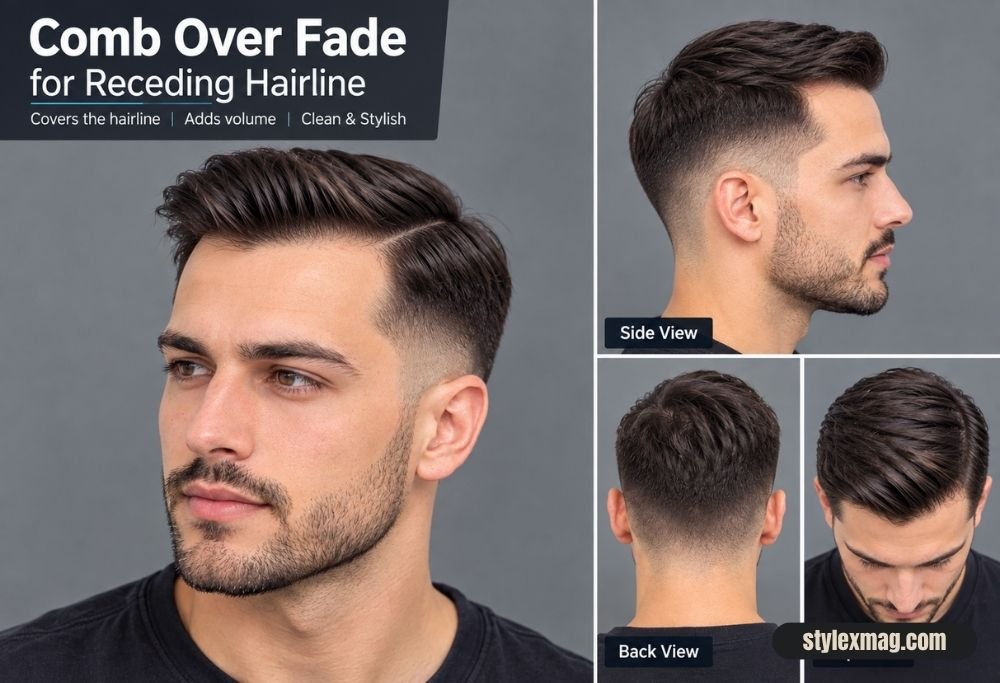
A receding hairline calls for a smart plan. Skip harsh, high contrast and choose a low taper fade instead. Keep the front a little longer so the sweep softens the temples. Work with the hairline instead of fighting it. A natural side part often looks better than a razor line here. Tell your barber: “Comb over with a low taper, keep the front slightly longer, blend the temples softly.” Visit every 4 weeks.
Asian Comb Over Fade
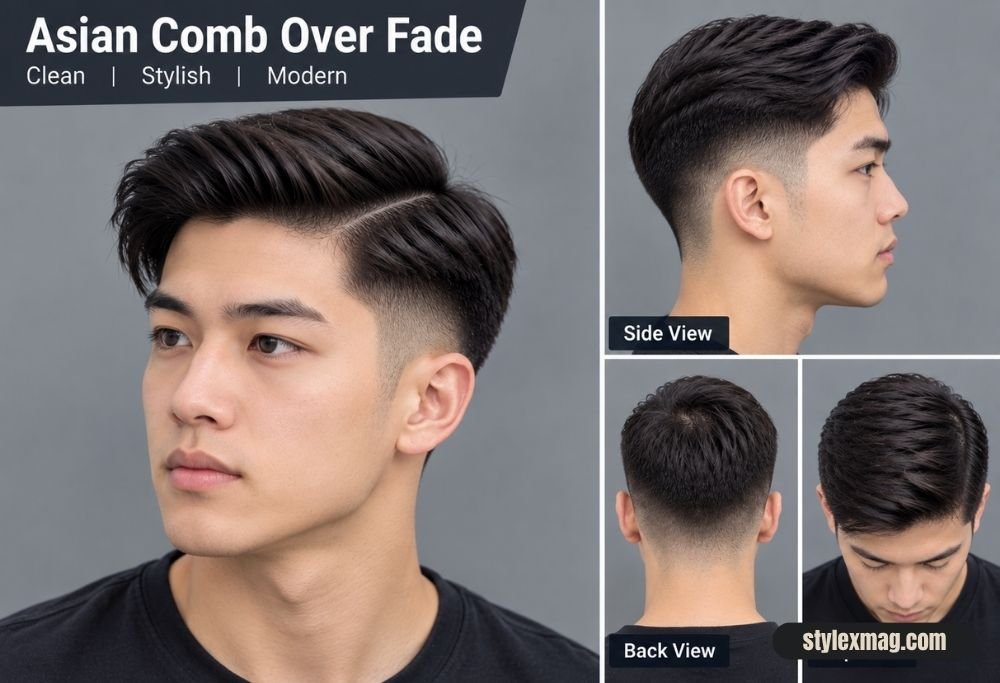
Many Asian men have thick, straight hair, and it suits this cut very well. The flat texture takes a hard part cleanly. It also holds a slick or textured finish with little product. A mid fade or undercut on the sides balances the heavy top. The precision of the part and the fade is the signature. Say: “Comb over fade, hard part, mid fade or undercut on the sides. I have thick straight hair.” Trim every 2 to 3 weeks.
Military Comb Over Fade
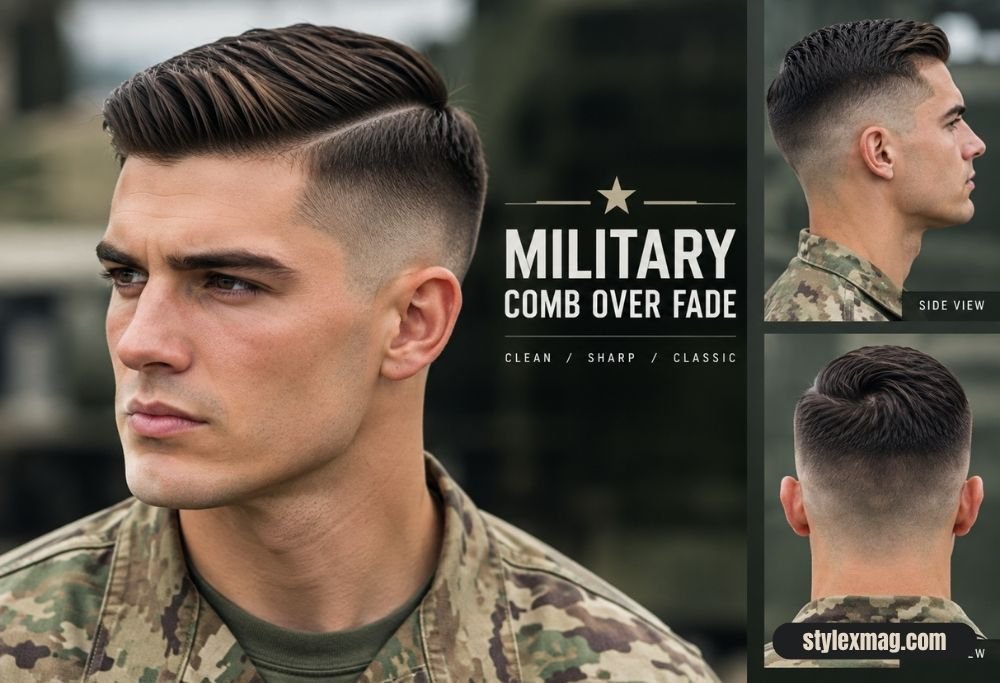
The military version stays neat and strict. It uses a tight taper or low fade with a short, conservative top. You get a professional hairstyle that meets most grooming rules. It’s also quick to style. Only a little hair wax or pomade is needed. Tell your barber: “Comb over with a tight taper, short conservative top, clean neckline, regulation-friendly.” Book every 2 to 3 weeks, since a short cut shows regrowth quickly.
Comb Over Burst Fade Mullet
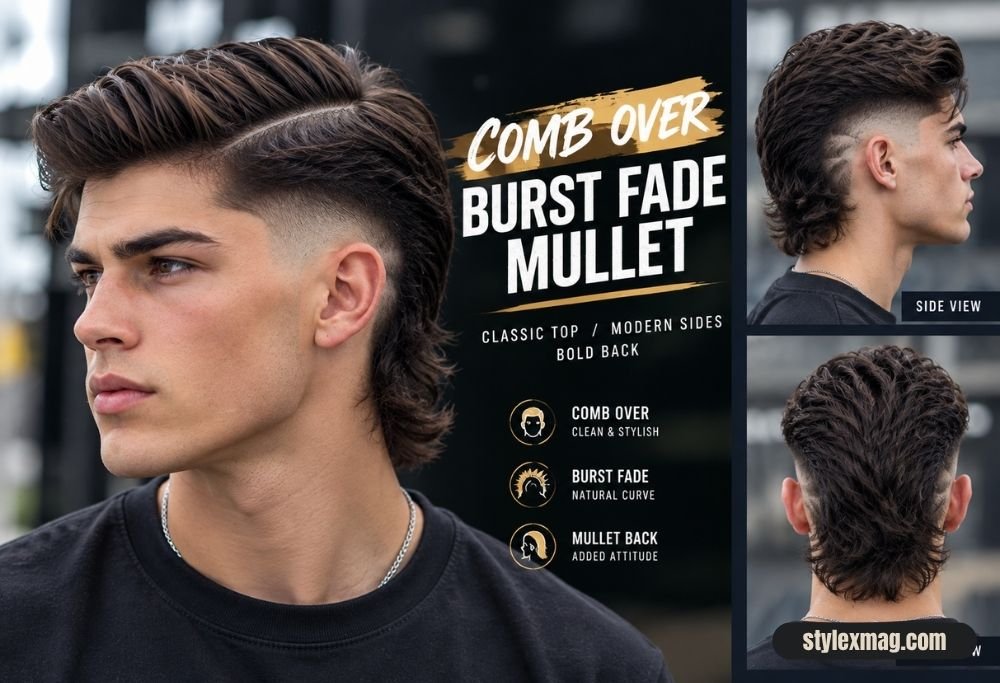
The comb over burst fade mullet mixes three ideas. The top sweeps to one side, the sides carry a burst arc, and the back stays long. The burst arc protects that back length, which a normal high fade would cut away. A textured top and tight sides keep it modern instead of retro. It suits oval and oblong faces, plus straight and wavy hair. Tell your barber: “Comb over on top, burst fade on the sides, leave the back long, don’t fade the back.” Visit every 3 weeks.
How to Choose the Right Comb Over Fade Haircut
Choosing well starts with four checks. Look at your face shape, your hair type, your length, and your hairline. Each one narrows your options. Together, they point to a cut that looks planned instead of random. A good barber consultation covers all four in a few minutes.
Don’t guess when you can measure. Take a photo of your head from the front, and check where your jaw and forehead sit. Then run your notes through the table below. It shows which fade level fits which face shape, so the comb over fade styles for men you pick will flatter you.
| Face Shape | Best Fade Level | Why |
| Oval | Any | Balanced proportions suit all levels |
| Round | Mid or high | Adds visual height and length |
| Square | Low or mid | Softens the jawline |
| Oblong or long | Low fade or taper | Avoids adding more length |
| Rectangular | Low or mid with deep part | Adds width |
| Heart | Low or mid | Avoids sharpening the temples |
| Diamond | Mid | Keeps side width balanced |
| Triangle | Low or mid with a fuller top | Balances a wide jaw |
Choose the Fade Level for Your Face Shape
Height adds length, and fuller sides add width. That simple rule guides everything. Round faces gain from a mid or high fade, since the tight sides stretch the face. Square faces prefer low or mid fades that soften the jaw. If you’re browsing triangle face shape hairstyles, look for a fuller, voluminous top with modest side contrast. The same advice holds for triangular face shape male hairstyles. A wider top balances a strong jaw and a narrower forehead.
Match the Cut to Your Hair Type
Your hair type decides the finish. Straight hair takes slick or classic styles best. Wavy hair loves a textured top. Curly hair does well with loose direction and a burst fade. Thick hair needs a mid or high fade to lose side bulk. Thin hair needs a low fade or a taper. Use this table as a quick guide.
| Hair Type | Best Version | Key Note |
| Straight | Slick or classic | Sharpest lines |
| Wavy | Textured | Waves add volume |
| Curly | Loose sweep, burst fade | Scissor-over-comb sides |
| Thick | Mid or high fade | Removes side bulk |
| Thin | Low fade or taper | Keeps sides full |
| Receding | Low taper | Works with the hairline |
Choose the Right Hair Length and Texture
Length controls what your comb over can do. One inch on top holds a basic sweep. Two to three inches adds volume and flow. Four inches or more gives you a dramatic, flowing look. Texture changes the finish. Smooth hair looks sleek, and textured hair looks lived-in. Before you cut, ask your barber to test the length by combing your hair sideways. If it stays put, you’re set.
Consider Your Hairline and Density
Your hairline and hair density decide how bold your fade can be. A receding hairline looks better with soft blending than with hard edges. Low density means less coverage, so a high fade shows more scalp. Dense hair can handle short sides and a heavy top. Feel your hair before the appointment. Note where it thins, and tell your barber. That small step prevents big regrets.
How to Ask Your Barber for a Comb Over Fade
A clear request prevents a bad haircut. Most mix-ups happen because “fade” means different things to different people. Two details cover almost everything. Give the fade height and the top finish. Add the length and the part for extra safety.
Bring simple words and a photo. Barbers work faster and better with clear targets. The table below shows what to say for each version. Keep it on your phone, and read from it if you need to.
| Style | What to Say |
| Low fade | “Low fade, just above the ear, natural side part, blended clean.” |
| Mid fade | “Mid fade at the temple, side part, blended clean.” |
| High fade | “High fade above the temples, tight on the sides.” |
| Skin fade | “Skin fade comb over, bald at the base, razor finish, mid height.” |
| Taper | “Comb over taper, keep some hair at the base.” |
| Hard part | “Add a razor hard part on the left, an inch from the hairline.” |
| Curly hair | “Set the fade height on dry hair, not wet.” |
Explain Your Preferred Fade
Name the fade level first. Say low, mid, or high. Then say whether you want a skin fade, a taper, or a burst. Point to where the fade should start on your head. A finger at the temple beats a vague word. If you feel unsure, ask for a gradual fade. It blends softly and forgives small errors.
Specify the Top Length and Part
State the top length in inches. Say “two inches” instead of “a bit off the top.” Then name the part side. Choose between a natural side part and a hard part. A hard part needs more upkeep. If you want a side-swept hairstyle with soft edges, skip the razor line. Clear numbers stop guesswork.
Show a Reference Photo
A photo saves you a thousand words. Pick one with a similar hair type to yours. A photo of a man with straight hair won’t help if you have curls. Show the front, the side, and the back if possible. Your barber can then explain what works and what doesn’t. That honest talk is the best part of any good visit.
How to Style a Comb Over Fade Haircut
Great styling takes about five minutes. You need a comb, a blow-dryer, and the right hair styling products. The routine below works for nearly every hair type. Small tweaks change the finish. Follow the order, and the cut looks like it came straight from the shop.
Product choice shapes the look. Pomade gives shine and control. Matte clay adds grip and texture. Hair wax sits in between, with flexible hold. Mousse adds lift for thin hair. This table pairs each finish with its best product.
| Finish | Best Product | Hold |
| Slick and shiny | Pomade | Strong |
| Textured and matte | Matte clay | Strong |
| Natural and flexible | Hair wax | Medium |
| Fuller look on thin hair | Mousse | Light |
| Wavy definition | Sea salt spray | Light |
Wash and Prepare Your Hair
Start with clean hair. Shampoo away oil and old product. Add conditioner to the lengths, especially if your hair runs dry. Then towel-dry until the hair feels damp, not wet. Damp hair takes product evenly and shapes easily. Wet hair dilutes everything.
Add a Pre-Styling Product
A pre-styling product builds the base. Use mousse for thin hair. Try sea salt spray for wavy hair. Reach for leave-in conditioner if you have curly hair. Work a small amount through the roots to the tips. This step helps the top hold its shape and gives your styling technique a solid start.
Create the Side Part
Find your natural part first. Push your hair back and see where it falls. Then use the tip of a comb to draw a clean line. For a deeper sweep, move the part further out. Keep the line straight. A neat part is the frame of the whole men’s comb over hairstyle.
Comb the Hair Into Place
Comb the top from the part across to the other side. Use slow, steady strokes. Work in small sections so no strands escape. Keep the comb flat against the scalp for a smooth finish. For a comb over with side part, this step decides how sharp the result looks.
Blow-Dry for Volume and Hold
Dry the hair in the direction of the sweep. Use medium heat and low airflow. Lift the roots slightly with your fingers as you go. This builds body without frizz. Finish with a cool-air burst to lock the shape. Skip this step if you prefer a sleek, flat look.
Finish With a Suitable Styling Product
Rub a pea-sized amount between your palms. Smooth it over the top from front to back. Use pomade for shine or matte clay for a dry finish. Start small since you can always add more. Too much product weighs the hair down. Check the mirror, and comb once more.
How to Maintain a Comb Over Fade
Fades lose their edge fast. Hair grows about half an inch a month, and the blend softens within days. That’s why upkeep matters. A fresh fade looks crisp. A grown-out one looks messy. Regular trims keep the look intentional.
Frequency depends on the fade. A high skin fade needs the most love. A taper needs the least. Book your next slot before you leave the chair. That habit alone keeps you on track. The table below shows the usual schedule.
| Variation | Frequency |
| High skin fade comb over | Every 1 to 2 weeks |
| Comb over with design | Every 1 to 2 weeks |
| Hard part comb over fade | Every 2 weeks |
| Mid fade comb over | Every 2 to 3 weeks |
| Burst fade comb over | Every 2 to 3 weeks |
| Low fade comb over | Every 3 weeks |
| Comb over taper fade | Every 4 to 5 weeks |
Schedule Regular Fade Trims
Match your visits to your fade level. Sharp fades need short gaps between cuts. Softer fades allow longer ones. Try this case study. Daniel, a composite example, wore a mid skin fade and visited every five weeks. His sides looked fuzzy by week three. He moved to every two weeks, and the cut looked sharp all month.
Keep the Top Shaped
The top needs a trim every 6 to 8 weeks. Ask your barber to remove split ends and keep the weight even. Use a gentle shampoo and a light conditioner. Comb the hair in the same direction each day. That habit trains the sweep and speeds up styling.
Follow a Simple Daily Hair Routine
Keep it short. Wash a few times a week, and rinse on other days. Style with a small dab of product. Comb once from the part outward. Then leave it alone. Touching your hair all day breaks the shape. A calm routine beats a complicated one.
Comb Over vs. Other Similar Hairstyles
People often mix up the comb over with a few cousins. The lines between them look blurry. Direction, volume, and finish set them apart. Once you know the differences, you can ask your barber for exactly what you want. This also helps when you browse men’s hairstyles online.
The table below compares the main options. Read across each row to see how they differ. Notice that the fade works with all of them. It’s the top that changes.
| Style | Direction | Volume | Hold | Formality |
| Comb over | Sideways | Low to medium | Medium | Medium to high |
| Side part | Sideways | Low | Light | Medium |
| Slick back | Straight back | Low | Strong | High |
| Pompadour | Up then back | High | Strong | Medium |
Comb Over vs. Side Part
A side part is a gentler cousin. The hair falls naturally to each side of the part line. A comb over sweeps most of the top across in one direction. The part sits deeper, and the sweep looks stronger. Choose the side part if you want a softer cut. Choose the comb over if you want a bolder line.
Comb Over vs. Slick Back
A slick back pushes the hair straight back. There’s no sideways direction. A comb over sweeps across the head from a part. The slick back looks sleek and formal. The comb over looks structured and versatile. Both pair well with a fade haircut.
Comb Over vs. Pompadour
The pompadour builds height at the front. The comb over stays flatter. A pompadour needs more length and stronger hold. A comb over needs less time and product. If you want drama, pick the pompadour. If you want polish, pick the comb over. You can also blend them, as the comb over fade pompadour shows.
Common Comb Over Fade Mistakes to Avoid
A few small errors ruin a good cut. Most are easy to fix. The biggest one is choosing the wrong fade height for your hair. Others include skipping trims, using too much product, and giving vague instructions. Spot these early, and you’ll avoid a lot of stress.
The table below lists the usual mistakes and their fixes. Save it, and check it before your next visit. A little care goes a long way with any comb over fade haircut for men.
| Mistake | Fix |
| High fade on thin hair | Choose a low fade or taper |
| Skipping upkeep | Book the next trim before leaving |
| Too much product | Use a pea-sized amount |
| Vague barber request | Give fade height, length, and part |
| Slick finish on curly hair | Use a loose, textured sweep |
| Wet hair check for curls | Set the fade on dry hair |
Frequently Asked Questions
Is a comb over fade good for men?
Yes. It suits most faces, hair types, and ages. You can wear it in a conservative office or at a weekend party. The modern men’s haircut stays neat with regular trims.
What fade looks best with a comb over?
A mid fade is the safest choice. A low fade or taper suits thin hair and conservative settings. A high fade suits thick hair and bold styles.
How long should the top be for a comb over fade?
You need at least 1 inch to hold a sweep. Two to four inches gives more freedom. Longer hair adds volume and a more dramatic flow.
Is a comb over fade good for thin or receding hair?
Yes, with the right approach. Choose a low fade or a low taper fade. Keep the front slightly longer to soften the hairline.
How often should you get a comb over fade?
Every 1 to 5 weeks, depending on the fade. High skin fades need the most visits. Tapers need the fewest.
Conclusion
The comb over fade earns its place among the best comb over haircut styles. It offers sharp lines, easy styling, and real flexibility. Whether you pick a low fade comb over, a bold skin fade comb over, or a relaxed textured comb over fade, you can find a version that fits. Match the cut to your face shape, hair type, and hair density.
Now it’s your turn. Choose a style, save the barber phrase, and book your visit. Style it with a little pomade or matte clay. Keep up with trims. Your best comb over fade styles for men are only one appointment away.
StyleXMag Editorial Team shares the latest haircut and hairstyle ideas, from modern fades and comb overs to curly, long, slick-back, and face-shape styles. Our goal is to make finding your next look simple, useful, and inspiring.